
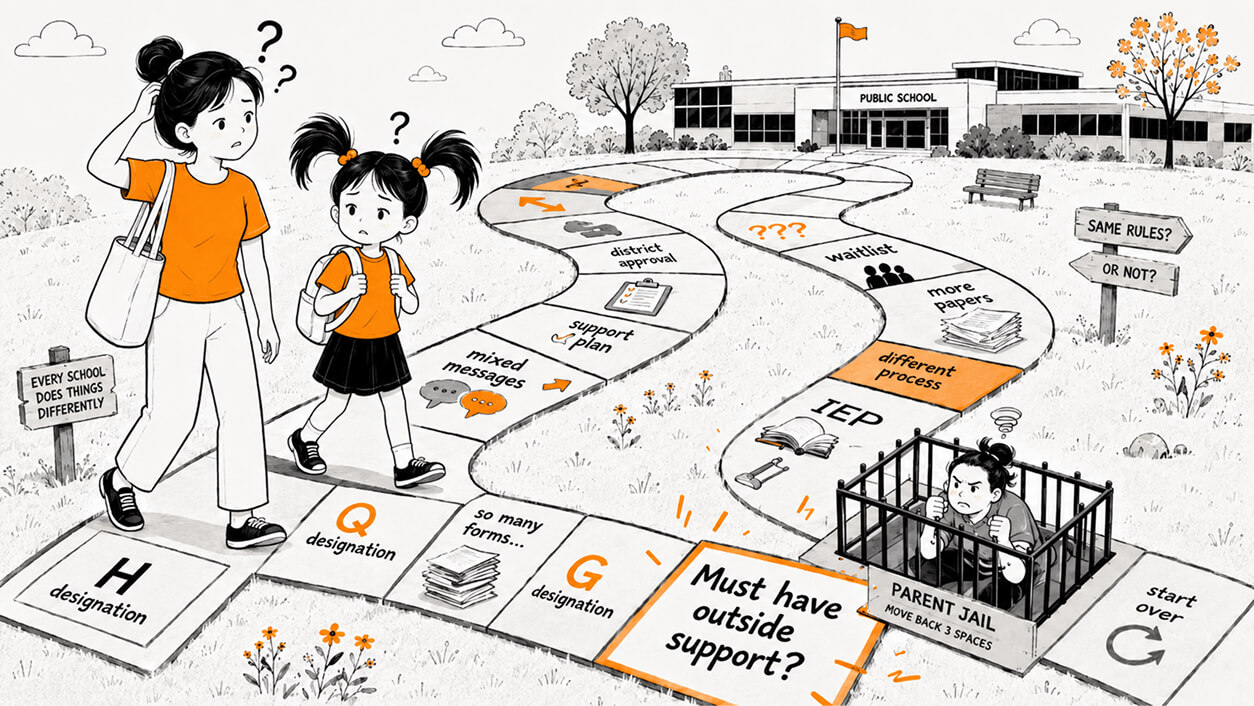
In a meeting, someone mentions a letter. Your child might be “a G,” or the team is “looking at an H,” or a staff member says there is no designation on file and so there is nothing more they can offer. The letters are confusing, and you are left translating a bureaucratic shorthand while working out whether your child needs one of them to be helped at all.
In British Columbia, the Ministry of Education uses designation categories to identify and report some students with disabilities or diverse abilities. Each category carries a letter. Some categories bring supplemental provincial funding to the district; others describe and document student need for reporting purposes only. Either way, the letters shape how the system counts, reports, and organises students. These are administrative categories, and they don’t supersede Human Rights.
The categories
This is an overview of the designation categories in BC:
- A — physically dependent
- B — deafblind
- C — moderate to profound intellectual disability
- D — chronic health impairment or physical disability
- E — visual impairment
- F — deaf or hard of hearing
- G — autism spectrum disorder
- H — intensive behaviour interventions or serious mental illness
- K — mild intellectual disability
- P — gifted
- Q — learning disability
- R — moderate behaviour support or mental illness
Finding the letter that might fit
The chart below can help you identify if your child fits neatly within the Ministry categories. Some needs, such as ADHD, speech and language, or motor planning and written output, sit across the categories and may not fit neatly into one letter, but that does not mean a child with these disabilities in ineligible for support.
%%{init: {'theme': 'base', 'themeVariables': { 'primaryColor': '#fbfaf3', 'primaryBorderColor': '#e69632', 'lineColor': '#000000'}}}%%

%%{init: {'theme': 'base', 'themeVariables': { 'primaryColor': '#fbfaf3', 'primaryBorderColor': '#e69632', 'lineColor': '#000000'}}}%%

flowchart TD
    A[Start here] --> B[Look at the main area of concern]

    B --> C{Mental health or behaviour}
    C -->|Yes| C1[Possible categories: R or H]
    C -->|No or not sure| D[Keep going]
    C1 --> D

    D --> E{Developmental, learning, or communication}
    E -->|Yes| E1[Autism → G]
    E -->|No or not sure| F[Keep going]

    E1 --> E2[Learning disability → Q]
    E2 --> E3[Intellectual disability → C]
    E3 --> E4[Speech language communication → may not map neatly]
    E4 --> E5[ADHD or executive functioning → may not map neatly]
    E5 --> E6[Motor planning or writing → may not map neatly]
    E6 --> F

    F --> G{Physical sensory or medical}
    G -->|Yes| G1[Physically dependent → A]
    G -->|No or not sure| H[Keep going]

    G1 --> G2[Deafblind → B]
    G2 --> G3[Chronic health or physical disability → D]
    G3 --> G4[Visual impairment → E]
    G4 --> G5[Deaf or hard of hearing → F]
    G5 --> H

    H --> I{Giftedness}
    I -->|Yes| I1[Gifted → P]
    I -->|No or not sure| J[Start with barriers]

    I1 --> J

    J --> K[Attendance]
    K --> L[Learning]
    L --> M[Regulation]
    M --> N[Safety]
    N --> O[Communication]
    O --> P[Participation]

    P --> Z[School support does not depend on designation]
    Z --> Z1[No designation does not mean no support]
    Z1 --> Z2[Designation does not cap support]
    Z2 --> Z3[The school must respond to disability related barriers]
The part the letters obscure
A designation does not decide whether your child gets support.
The letters are used for Ministry reporting and, in some cases, supplemental funding. They are not a cap on accommodation. They are not permission for the school to ignore needs that fall outside a clean category. They are not a substitute for asking what is actually getting in the way of your child’s access to school. Under the Human Rights Code and the reasoning in Moore v. British Columbia, the school has a standing duty to give your child meaningful access to education and to remove the disability-related barriers in the way.
No designation does not mean no support.
A designation does not mean support is capped.
The real question is simpler and harder to evade: what barriers exist, and what will the school do to remove them?
Troubleshooting designation confusion
Schools sometimes move the conversation into codes, categories, funding, staffing, and “qualification” before families understand what has happened. That confusion matters. It can make parents think the school has no obligation unless a Ministry designation is approved.
That is not right.
A designation may matter for district reporting and funding. It may help unlock attention, documentation, or staffing. But it is not the source of the child’s right to support.
Fact checking
Here’s some examples of information and ideas circulating in schools and what to try instead:
“You cannot get an IEP unless your child has a Ministry designation.”
This is often said as if it is law. It is not.
In BC, the School Act is the statute. Ministerial Orders sit under the School Act and are made under authority given by the Act and can set requirements boards are expected to follow. The IEP Order, for example, is made under section 168(2)(a) of the School Act and says a board must design an IEP for a student with disabilities or diverse abilities as soon as practical after the student is identified, unless the narrow exception applies.
District procedures, school habits, audit worries, MyEd limitations, staffing practices, and “how we usually do it here” are not the law. They are administrative interpretations of the legal framework. They may explain how the school behaves, but they do not decide what your child is entitled to receive.
BC’s IEP Order does not say a student must have a Ministry designation before they can have an IEP. It says boards must design an IEP for a student with disabilities or diverse abilities as soon as practical after the student is identified, unless the narrow exception applies.
In practice, schools may resist IEPs without designations because designation, funding, 1701 reporting, and audit files have become tangled together. That may explain the resistance. It does not make the resistance correct.
Also see:
- Individual Education Plan Order M638/95: the Order says a board must design an IEP for a student with disabilities or diverse abilities as soon as practical after the board identifies the student that way. It does not say “after the student receives a Ministry designation” or “only if the student has a funded code.”
- Inclusive Education Services: A Manual of Policies, Procedures and Guidelines: The Ministry’s public inclusive education page also summarises this clearly: M638/95 “sets out the requirements for Boards of Education to design and implement individual education plans for students with disabilities or diverse abilities.” Again, no funded designation requirement is stated.
- K-12 Funding — Inclusive Education: That page says supplemental Inclusive Education funding is paid to boards for reported funding categories, and that those funds are not targeted to specific students. It also says the Basic Allocation includes funds to support students with other disabilities or diverse abilities, including learning disabilities, moderate behaviour support or mental illness, and gifted students.
In practice, getting an IEP without a designation may be an uphill battle because many schools treat designations as the doorway to formal planning. That does not make it lawful to delay support. It may be practical to pursue the most relevant designation while also insisting that barriers be identified, documented, and addressed now.
Try this instead
“I understand the district may have audit, reporting, and designation processes to manage. Those are administrative issues. They do not change the IEP Order, and they cannot be used to delay support. My child has disability-related needs affecting access to education. I am asking what barriers the school has identified, what supports will start now, who is responsible, and when we will review whether they are working.”
“There is no ADHD code, so your child cannot have an IEP.”
ADHD does not have its own standalone funded Ministry category in BC.
That does not mean ADHD is irrelevant. It does not mean the child has no disability-related needs. It does not mean the school can ignore barriers connected to attention, executive functioning, regulation, attendance, written output, anxiety, transitions, or participation.
The absence of an ADHD funding code is not the absence of a duty to accommodate.
Try this instead
“I understand that ADHD does not have its own funding code. That is not the question I am asking. I am asking how the school will accommodate my child’s ADHD-related barriers to education.”
“Your child does not qualify for H because they are not seeing a counsellor.”
Outside support may help with documentation. It may be relevant to a designation application. But outside therapy is not the starting point for the school’s obligation to respond.
Some children are on waitlists. Some families cannot afford private services. Some children cannot tolerate new professionals. Some needs are already visible through school records, attendance, parent reports, medical letters, classroom observations, and the school’s own experience with the child.
The school cannot use a waitlist or lack of private services as a reason to do nothing.
Try this instead
“Outside documentation may be relevant to a designation. The school may choose to apply for designation if the school wants to pursue that. That is not a reason to delay support. My child’s needs are already known to the school. I am asking what support will start now.”
“Your child is not disruptive enough for support.”
Schools often respond fastest to visible crisis. That does not mean quiet distress is less serious.
A child does not have to run, hit, elope, scream, or disrupt the class before their needs matter. A child who masks, shuts down, avoids school, becomes anxious, stops eating, freezes, or collapses at home may still be facing serious disability-related barriers.
Support should follow need, not adult inconvenience.
Try this instead
“My child does not need to become disruptive before their needs count. The barriers are affecting attendance, regulation, learning, and well-being. I am asking the school to respond to those barriers, not wait for a crisis.”
“There is no funding for that support.”
Funding explains how districts receive and organise money. It does not decide what a child needs.
Districts may face real scarcity. Staff may be stretched. Principals may be working inside district triage systems. But funding language should not replace the accommodation question.
The question is not “what does the category pay for?”
The question is “what does this child need for meaningful access?”
Try this instead
“Funding is a district issue. My child’s access to education is a rights issue. If the school says the needed support cannot be provided, I need that decision and the reasons in writing.”
“A support plan is the same thing as an IEP.”
A support plan may be useful. It may document strategies and accommodations. But it is not automatically the same as an IEP.
If the school offers a support plan instead of an IEP, the parent should ask what the plan includes, who must follow it, how staff will know about it, when it will be reviewed, and why the school believes an IEP is not required.
Try this instead
“A support plan may be useful, but it is not a substitute for an IEP when a child’s disability-related needs require formal planning. If the school is choosing a support plan instead of an IEP, I need that decision in writing. I also need the school to explain why it believes the IEP Order does not apply, what supports will be provided, who is responsible for each support, and when we will review whether the plan is working.”
“Your child is doing fine.”
“Doing fine” often means “not causing visible difficulty for adults.”
A child can have good grades and still lack meaningful access. A child can be polite, quiet, and compliant while using every bit of energy to survive the day. A child can meet expectations while becoming sick, exhausted, anxious, avoidant, or unable to function at home.
Performance is not the same as access.
Try this instead
“Grades and behaviour at school are not the whole picture. My child’s disability-related needs are affecting access to education. I am asking the school to consider [attendance, executive functioning, anxiety, fatigue, and what happens after school].
“The teacher has too many IEPs already.”
Class composition is a system problem. It is not a lawful reason to ignore an individual child’s disability-related needs.
Teachers may be under real pressure. Classrooms may be under-resourced. But that does not cancel a child’s accommodations.
If staff cannot implement required accommodations because of workload or class composition, the school and district need to solve that resourcing problem.
Try this instead
“Class composition does not cancel my child’s right to accommodation. If the current classroom cannot implement the plan, the school and district need to explain how they will fix that.”
“We need more assessment before we can do anything.”
Assessment can be important. It can clarify needs and strengthen planning. But assessment delays should not become support delays.
Schools can provide interim accommodations based on what they already know. They can respond to attendance, distress, executive functioning, written output, sensory needs, regulation, and safety while more information is being gathered.
Try this instead
“Assessment can continue, but support cannot wait. The school already knows my child is facing barriers. I am asking what interim accommodations will start now.”
“A designation tells you how much support your child gets.”
A designation does not equal a fixed number of EA hours. It does not automatically create one-to-one support. It also does not cap support.
Funding categories help the province and district organise money. They do not define the child’s full support package.
The child’s needs should drive the plan.
Try this instead
“A designation is not a cap on support. I am asking what support my child needs to access education, not what the school thinks the category covers.”
“If your child does not fit a category, there is nothing we can do.”
Some children fit cleanly into Ministry categories. Some do not.
Either way, the school still has to respond to disability-related barriers.
A child may need support because of ADHD, anxiety, executive functioning, sensory overload, trauma, school avoidance, communication differences, motor planning, written output, chronic health, or other needs that do not map neatly onto a funded category.
No clean category does not mean no support.
Try this instead
“My child does not need to fit neatly into a funding category before the school has to respond. The issue is the barrier to education. I am asking what the school will do to remove it.”
“We cannot promise a support person.”
A school is not required to provide the exact support a parent asks for. But the school is required to provide accommodation that actually addresses the barrier.
If the school refuses a specific support, it should explain what it will do instead and why that alternative is expected to work.
Try this instead
“I understand the school may propose a different accommodation. I need to know what support will be provided instead, why the school believes it will address the barrier, and how we will know whether it is working.”
“Your child can only attend part-time because there is not enough support.”
A reduced schedule should not be used as a staffing solution.
If a child is attending part-time because the school says there is not enough support, that is an access problem. The school should identify the barriers, provide accommodations, involve the district where needed, and work toward restoring full access.
Try this instead
“A reduced day cannot become the solution to a staffing problem. My child has a right to meaningful access to education. I need a written plan showing what barriers prevent full attendance, what support will be provided, and how full access will be restored.”
“The district decides designations, so the school cannot do anything.”
District processes may affect designation applications, staffing requests, or funding reports. They do not stop the school from supporting the child now.
The school still has to identify barriers, document needs, provide accommodations, communicate with staff, and involve district resources where school-level resources are not enough.
Try this instead
“The district process can continue. It does not prevent the school from supporting my child now. I am asking what the school will do today, and what will be escalated to the district.”
“We will monitor and see.”
Monitoring is not a plan unless something is being done, recorded, and reviewed.
Schools sometimes use “wait and see” language when they are delaying support. If a child is already struggling, monitoring should come with interim accommodations and a review date.
Try this instead
“Monitoring is not enough on its own. My child is already facing barriers. I am asking what support will start now, what will be tracked, and when we will meet to review whether it is working.”
The validation trap
There is a hard disconnect between what the legal framework says and what families often experience in practice.
On paper, support should follow disability-related need. The School Act is the law. Ministerial Orders sit under the School Act and set requirements boards are expected to follow. District procedures, audit practices, funding habits, MyEd limitations, staffing practices, and “how we usually do it here” sit below that. They may explain how a school behaves. They do not rewrite the legal framework.
In practice, families are often pulled into a different conversation.
- Does your child qualify for a designation?
- Does your child fit H?
- Will the file survive audit?
- Is there enough outside documentation?
- Is the paperwork strong enough?
- Can MyEd even generate the IEP without a code?
This is the validation trap.
A parent starts by saying, “My child cannot access school.” The system answers by asking whether the child can be validated through the system’s preferred paperwork.
That paperwork may matter. A designation can help the district report the student, organise funding, and justify staffing. An IEP can help document goals, accommodations, responsibilities, and review dates. Families may reasonably pursue both.
But neither the designation nor the IEP is the right itself.
The right is access. The issue is the barrier.
This matters because designation processes can be shaped by pressures parents do not see. Schools and districts may be cautious because designation files can be audited. They may worry that a child does not clearly fit a category, that documentation is incomplete, or that a file will be rejected later. In some districts, designations have been removed after audit. That kind of experience can make schools risk-averse. Staff may become reluctant to put a child forward unless the file is clean, obvious, and defensible.
That may explain the resistance. It does not make the resistance acceptable.
A designation review asks one question: does this file meet the criteria for this category?
Accommodation asks a different question: what barriers are affecting this child’s access to education, and what will the school do to remove them?
A child can lose the first question and still matter under the second. A child can fall between categories and still need support. A child can lack perfect paperwork and still face obvious barriers. A child can be hard to classify and still be struggling every day.
This is why families can get stuck fighting the wrong fight.
- If you fight only for an IEP, the school can make the conversation about why an IEP is not required.
- If you fight only for a designation, the school can make the conversation about why the category does not fit.
- If you fight for barrier removal, the school has to answer the harder question: what is stopping this child from accessing education, and what are you doing about it?
Use the paperwork. Do not worship the paperwork.
Ask for the designation if it fits. Ask for the IEP if formal planning is needed. But do not let either process become the place where support goes to wait.
- If the school says no designation, ask what support will start anyway.
- If the school says no IEP, ask how the child’s needs will be documented and reviewed.
- If the school says more assessment is needed, ask what interim accommodations will begin now.
- If the school says the file may not survive audit, ask what that has to do with the barriers your child is facing today.
The strongest question is usually the simplest one:
What barrier is affecting my child’s access to education, and what will the school do to remove it now?