
Families of disabled children are sometimes told, directly or indirectly, that they are not doing the “bare minimum.” This can sound like ordinary school advice: make sure your child attends, make sure they have a coat on a cold day, check the report card, clean out the backpack, know the teacher’s name, read with your child, check the online portal, and show that you value education.
For some families, those tasks may be useful. But for families whose children are disabled, excluded, traumatised, chronically overwhelmed, or unable to attend school safely, this kind of “bare minimum” checklist can become brutal.
It treats visible school participation as proof that a family cares. It can also treat a child’s disability-related barriers as evidence that the parent has failed.
Why “bare minimum” can be misleading
A school may see a child who is not attending regularly, not completing work, not having a coat on a chilly day, not using the planner, not handing in assignments, not reading at home, not checking grades, or not arriving prepared.
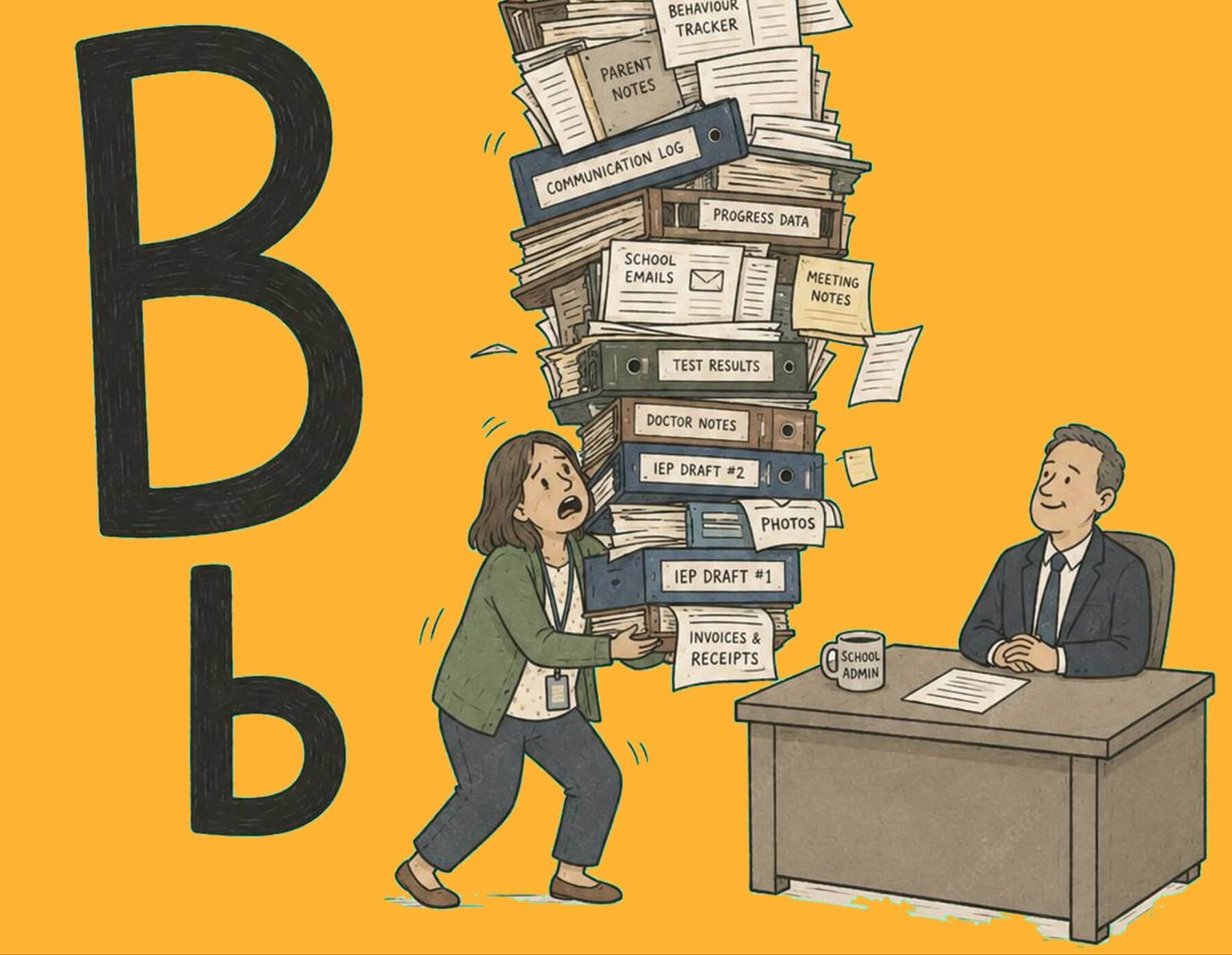
What the school may not see is the work happening before and after school: hours of co-regulation, medical appointments, therapy, emails, advocacy, safety planning, morning distress, after-school collapse, sensory recovery, relationship repair, food support, sleep support, transportation problem-solving, sibling care, and trying to keep the family functioning.
Many families are not doing less than other families. They are doing far far more. The difference is that their labour may not produce the school-facing signs that staff recognise as “engaged parenting.”
A parent can be doing extraordinary work and still have a child who cannot access school.
A parent can be doing extraordinary work and still have a child who cannot access school.
Why checking grades may not matter when access has already broken down
Schools sometimes tell parents to check report cards, online portals, marks, missing assignments, or teacher comments. That may help when a child is attending, learning, and simply needs ordinary reminders or organisation support.
But if a child has been excluded, sent home, placed on a partial day, avoiding school because of distress, or unable to access instruction, the report card may not tell the real story.
A low mark may not mean the child did not try. Missing assignments may not mean the parent failed to supervise. Blank spaces in an online portal may not mean the family ignored school. They may mean the child was not given meaningful access to instruction, support, regulation, safety, or belonging.
When access has broken down, the first question is not “Why didn’t the parent check the grades?”
The first question is: “What barriers prevented the child from participating in education, and what has the school done to remove those barriers?”
Also see Unlocking rights-based language for school advocacy
Attendance is not always within the parent’s control
Families are often told to “just make them go.” But disability-related school avoidance is not the same as ordinary reluctance. Some children cannot attend because school has become unsafe, overwhelming, unpredictable, humiliating, inaccessible, dangerous, or associated with repeated failure.
This can happen when a child has been restrained, secluded, bullied, shamed, sent home, punished for disability-related behaviour, placed on a reduced schedule, denied needed supports, or expected to function in an environment that overwhelms their sensory, communication, or regulation capacity.
A parent may be trying every morning. They may be waking the child, reducing demands, offering choices, emailing the school, arranging transportation, using scripts, preparing food, supporting regulation, and trying to avoid escalation.
If the child still cannot attend, the solution is not to blame the parent. The solution is to identify the barrier and change the plan.
Also see Exclusion you can’t see: how BC schools remove disabled students without suspending them
“Know the teacher’s name” is not the same as meaningful communication
Parents are sometimes judged by whether they attend meetings, answer emails quickly, check apps, know every staff member, ‘collaborate’ effectively, or use the school’s preferred communication system.
But many families are already managing a heavy load. Some parents are disabled themselves. Some are working shifts, caring for other children, navigating poverty, dealing with trauma, managing language barriers, or recovering from years of conflict with the school system.
A parent should not have to perform constant availability to prove they care about their child’s education.
The more serious the child’s barriers are, the more important it is for the school to communicate clearly, in writing, and with concrete next steps. Families should not be expected to piece together a plan from scattered emails, hallway comments, vague updates, and portal notifications.
Also see Pruning the garden: on structural inequity in schools
Cleaning out the backpack does not fix an inaccessible plan
Backpacks, planners, binders, lunch kits, and online portals are often treated as signs of family organisation. But many disabled children struggle with executive function, memory, transitions, motor planning, interoception, anxiety, demand avoidance, sensory overwhelm, or fatigue.
A chaotic backpack may be information. It may show that the child needs direct executive-function support, fewer materials, a visual system, a second set of supplies, a check-in routine, or a plan that does not depend on the child independently managing school logistics.
It should not be used as proof that the parent does not care.
I want to tell you directly that I never had an organ agenda or a locker and I have been a professional success. The point is to find accommodations that make your child’s life manageable not to force them to do things that are hard.
Also see Solving problems at school: accommodation and IEP failures
What families can ask instead
If the school says you are not doing the basics, you can calmly move the conversation back to access, barriers, and responsibilities.
You might say:
- “Can you please identify the specific barrier you believe is preventing my child from participating?”
- “What support is being provided at school to address that barrier?”
- “How is the school documenting the impact of the current plan?”
- “If the concern is attendance, what disability-related barriers has the school considered?”
- “If the concern is missing work, when was my child actually given accessible instruction and support to complete it?”
- “If the concern is organisation, what executive-function supports are being provided during the school day?”
- “If the school believes there is something specific I need to do at home, please put that request in writing and explain how it connects to my child’s access to education.”
A sample response to the school
You can adapt this:
“Thank you for your message. I understand the school is concerned about attendance, assignments, and home follow-through. I want to be clear that our family is putting significant daily effort into supporting my child’s education. However, the current concerns appear to be connected to disability-related barriers to access, not a lack of care or basic parenting.
Before focusing on report cards, missing work, backpack organisation, or online portal checks, I would like the school to identify the barriers that are preventing my child from participating meaningfully in school. Please explain what supports are currently in place, what data the school is using to assess whether those supports are working, and what changes will be made if my child continues to be unable to attend or complete work.
I am willing to collaborate. I am not willing to have my child’s disability-related barriers reframed as a failure of our family to value education.”
The key point
Families should not be judged by whether they can perform the “bare minimum” of ordinary school parenting when their child is not receiving ordinary access to school.
For many disabled children, the real issue is not that the family has failed to support education. The issue is that the child’s access needs have not been properly understood, planned for, or accommodated.
A fair school process should ask what is getting in the way, what support is needed, who is responsible for providing it, and how everyone will know whether the plan is working.
Blaming the family is not a plan.