

The building manager stood on the patio, visibly satisfied. The planters around the edge had filled in over the season — the plants were thriving, spilling over their containers, dense and green. He’d conducted an investigation. He had answers.
The gardeners had identified the problem and he had confirmed it: the plants were blocking the sprinkler heads. Some sections weren’t getting watered because the growth was too vigorous.

He declared with confidence:
“they’ll need to prune the plants, to keep the planters half-full so the existing sprinkler system can function properly.”
I nodded and walked away thinking: the plants are supposed to grow. Maybe you could add more sprinkler heads?
But three people — the gardeners who would bill hours for the pruning, and the building manager who would solve the problem without additional funding — had arrived at the same diagnosis. The investigation was thorough.
This is how schools diagnose disabled children.
The team convenes. They produce a report identifying the problem: this child requires containment. The child’s behaviour — their desire to participate, their sensory needs, their emotional intensity, their refusal to perform neurotypicality — is blocking the system’s capacity to function. The solution is clear. Partial schedules. Safety plans. Behaviour protocols. Room clears. Keep the child half-integrated so the existing classroom structure can operate.
The investigation is thorough. Nobody is acting in bad faith. The conclusion was structurally guaranteed from the beginning.
The outcome felt so inevitable. We look at our own actions and often feel an uneasy culpability.

The infrastructure problem gets reframed as a child problem
In 2020, a term went viral in China: Nèi juǎn (内卷), or involution.
It describes a system that intensifies inward on itself — more effort, more competition, more energy expended, with the same or diminishing returns. It originally described farmers farming rice but running out of land and more and more farmers farming the same amount of land but not producing the same personal benefit.
Young people work twice as hard and end up in the exact same position. They describe working 996, meaning 9 am to 9 pm six days a week.
The system has organised itself so that exhaustion is the fuel it runs on.
Public education in Canada has learned to run on this logic.
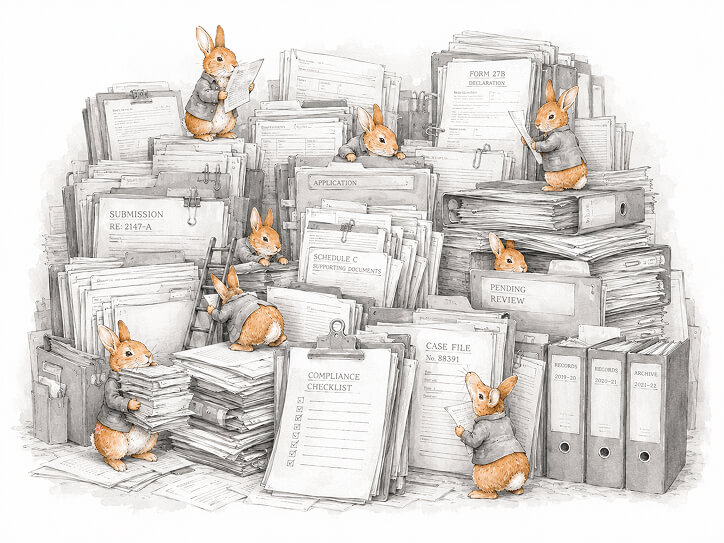
Teachers write more detailed behaviour plans to satisfy accountability requirements. The plans require more administrative review. Review generates more corrective directives. Which require more documentation. Which leaves less time for actual support. Outcomes worsen. Accountability tightens. No one escapes by working harder. The involution is the point.
For families of disabled children, the mechanism is vicious. You produce more evidence, attend more specialist appointment, log more complaints, write more meeting notes, correspond more with your lawyer. The system’s response is to generate more process for you to navigate. The complaint becomes the workload becomes the exhaustion becomes the withdrawal becomes the compliance. You’ve been pruned into compliance through the sheer labour cost of resistance.
The system doesn’t need more sprinkler heads. It has learned to metabolise the proof of insufficiency as a cost of operation.
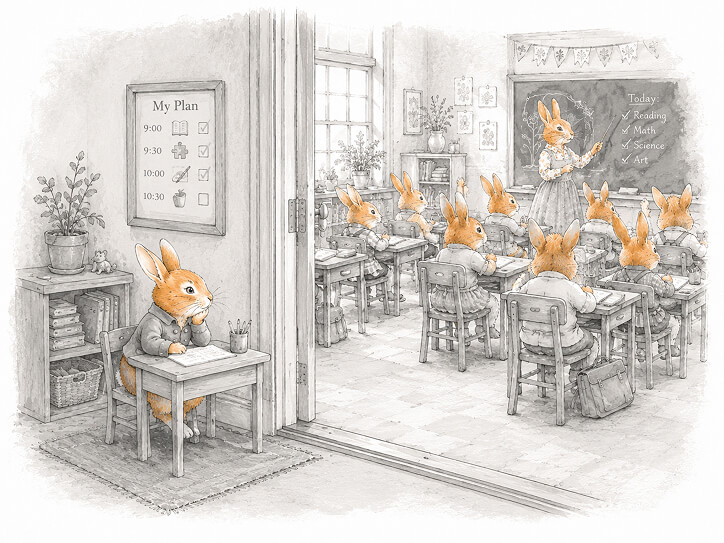
The box-checkers get funded. The conditions don’t.
There is funding for the meeting. Funding for the behaviour plan. Funding for the coordinator to manage it. Funding for the data collection and the documentation and the risk mitigation strategy. You can show a funder: here is the safety plan, here is the behaviour tracking, here is the evidence that we identified and addressed the problem.
But funding for an educational assistant who stays with a child for the full day? Funding for a classroom teacher with a caseload small enough to actually differentiate instruction? That’s not a checkbox. That’s a cost centre that doesn’t produce reportable evidence of its own necessity. It’s prevention. It’s invisible. It only becomes visible when it’s absent — when the child is harmed. Making the conditions feasible for the child to remain in the classroom is more expensive than making the conditions impossible for the child to endure.
So the system gets better at documenting the problem and worse at solving it. More meetings. More data. More plans. The child stays half-scheduled because the thing that would actually fix it — sufficient staffing, genuine classroom capacity, the slack in the system that allows for growth — has no funding stream, no reporting requirement, no way to justify itself within the fiscal logic that governs schools.
The box-checkers are not villains. They’re doing the work that exists, that’s been funded, that they’re employed to do. The system has just organised itself so that doing the work well is completely decoupled from whether the child gets what they actually need.
The language does the work for them.
On k12complaints.ca, I created a section called “Solving problems at school.” When I wrote it, I meant: dealing with the staff who are the problem, navigating around institutional obstacles, getting accountability from people creating harm. But the language I used erased that specificity and defaulted to the school’s frame.
“Solving problems at school” implies the school is the problem-solver. It positions families as seekers of institutional help in fixing the problem: the child. It naturalises the school’s authority over the frame. The language does the institutional work without anyone needing to state it explicitly. The system doesn’t have to argue that the child is the problem — the language argument has already been won.
This is institutional capture at the granular level. Not through coercion or bad faith, but through the adoption of frameworks so familiar they seem neutral.
What I meant was: navigating the structural inequities that schools have built and refuse to dismantle. What the language said was: help us help you solve your child.

What thriving would require.
The system knows how to fund problems. It doesn’t know how to fund conditions. Safety plans are interventions. Slack in the system, time, genuine responsiveness, the presence of an adult who knows a child’s actual needs — those are conditions. They emerge from relational capacity, not from protocols applied to a problem.
A system organised around metrics for thriving would require admitting that thriving requires resources that currently don’t get deployed. It would require a budget conversation that starts from “what would it look like for this child to actually flourish” rather than “how do we manage this risk within the funding we have.” Those are incompatible questions. One forecloses the other.
The plants could be full and thriving if the infrastructure matched. Instead they’re kept at half-capacity indefinitely. The pruning is permanent. The reports say the situation is addressed. And nobody has to admit that they just didn’t install enough sprinkler heads.
The system is working exactly as it’s designed to work.