
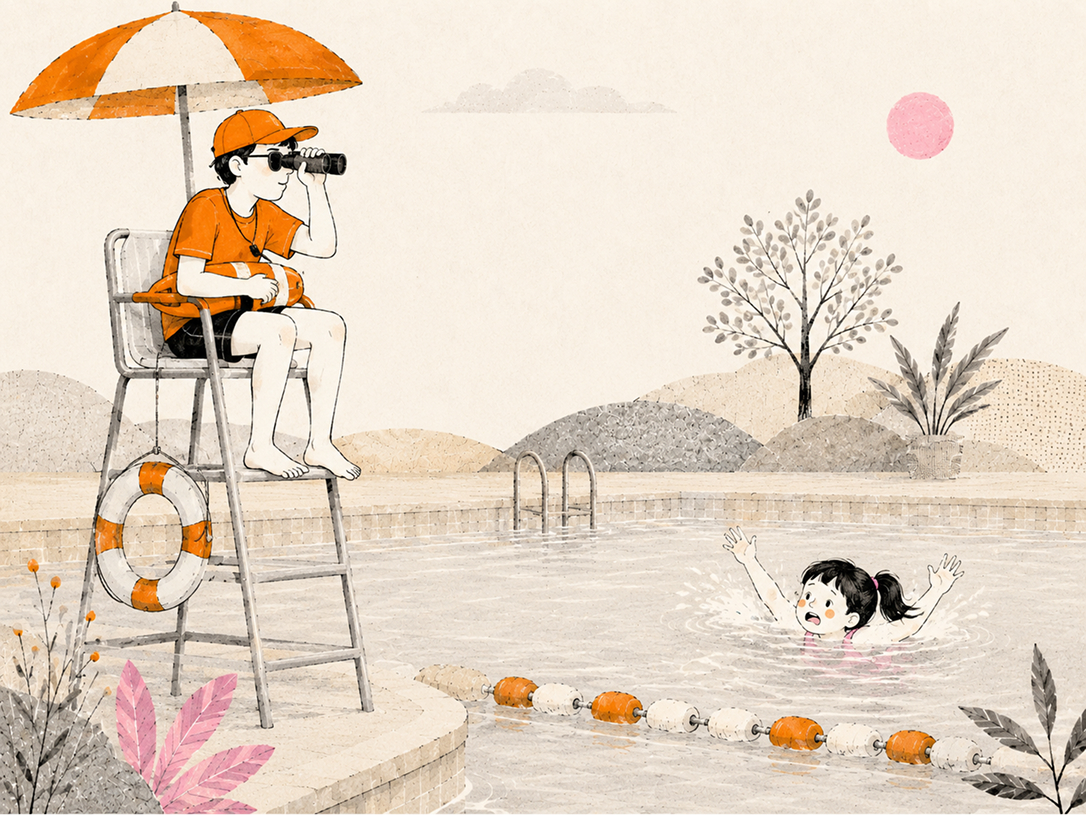
At the pool, some children get a lifejacket and nobody argues.
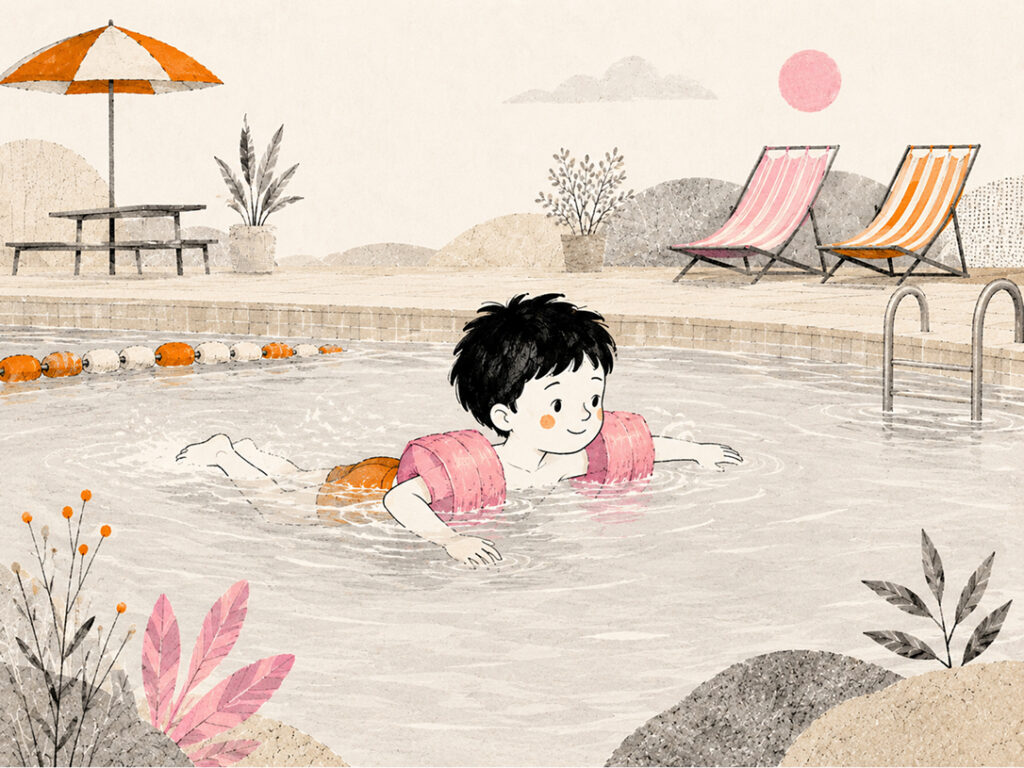
Some get water wings or a caregiver hovers. Everyone can see the support. No one calls the child dependent for wearing it. No one suggests that resilience would be better built by leaving a small body alone in deep water.
But some children can look like they are swimming.
They kick hard enough to keep their faces above the surface. They smile when an adult glances over. They make it from one side to the other, once or twice. They learn to keep their expression calm while their whole body strains underneath.
Then the adults call it success.
In school, this is where many neurodivergent, disabled, and traumatised children disappear.
My own experience comes through autism, but the pattern is bigger than autism. These are autistic children, ADHD children, children with FASD, learning disabilities, anxiety, trauma histories, PDA profiles, and children labelled oppositional, defiant, avoidant, difficult, or not trying.
The common thread is not diagnosis.
The common thread is a child whose support needs are real, and a system that has no clean place to put them.
They are not flagged as needing intensive support or a specialised placement. They are verbal, bright, polite, funny, capable. They do not blow up the classroom every day. They can perform fine for just long enough that the adults believe the plan is working.
Looking like you are swimming is not the same as being safe in the water.
The missing middle
There is a group of neurodivergent, disabled, and traumatised students who fall into a gap the system built and then refuses to see.
They need more than the regular classroom currently offers, and they are judged too capable for the programs, placements, and staffing designed for the most visible needs.
This is the missing middle.
They may have not have a wheelchair or need medical equipment support. They finish work sometimes, follow instructions sometimes, socialise sometimes, and look calm sometimes.
School is still costing them everything they have.
Noise, transitions, crowded hallways, substitute teachers, group work, assemblies, lunchrooms, constant correction — they spend so much energy surviving the environment that almost nothing remains for learning.
When parents ask for help, they hear that the child is too capable for specialised support. When the child falls apart, they hear that their was behaviour.
Too capable for help.
Too complex for school.
“It did not matter how hard my daughter was struggling. They saw a nice, polite, conscientious girl. Even when she stopped eating and fell off the growth chart, they still would not recognise that she needed support.”
— Just a parent
Schools notice drowning too late
In a pool, a child does not have to sink to the bottom before an adult moves.
The whole point of a lifejacket is prevention. The whole point of a lifeguard is to catch the danger before the child is under.
Schools run the opposite logic.
Families are asked to wait until the harm is undeniable. The child has to miss enough school, melt down enough times, shut down for long enough, stop eating, stop sleeping, stop trusting adults, stop being able to walk through the door, stop being able to hold the mask in place.
Only then does the struggle begin to count.
By that point, the file describes attendance, anxiety, behaviour, refusal, avoidance, or family difficulty. The record shows a child who is no longer attending and no longer coping.
What it never shows is the months that child spent barely staying afloat with a calm face.
Calm gets mistaken for coping
Many children in the missing middle mask, and masking is the most expensive thing a body can do.
A child can be silent at school and explosive at home. Compliant all day, then collapsed in the car. Capable of the work on Monday and unable to start it on Tuesday. Academically able, and entirely undone by the sensory, social, and executive load required to show what they know.
So the school says:
- “They seem fine here.”
- “We do not see that behaviour at school.”
- “They just need to build resilience.”
- “They can do the work when they want to.”
- “They do not need that level of support.”
And the parent, at home, is watching morning panic, after-school meltdowns, stomach aches, lost appetite, aggression with siblings, skill loss, and a child who spends every evening and weekend recovering from a single day.
Those things are not separate from education.
A child who can attend only by detonating at home is not safely and meaningfully accessing school. A child who looks calm because she has trained herself to bury distress is surviving, not coping.
The composure is the symptom.
“My child was praised for coping while she was falling apart. The school saw compliance. I saw the cost.”
— Just a parent
The water wings were never the problem
Schools talk about support as a thing to remove.
From the first meeting, the plan is the fade: build independence, build resilience, build tolerance, teach the child to cope with less, then less, then less, until the child is in deep water with nothing and the silence gets recorded as progress.
This is independence dogma, and it is the most respectable cruelty in the building.
It works because it sounds like wisdom. Nobody wants a child to depend forever. Everybody wants children to grow. So when a teacher says your child needs to “build tolerance for the classroom” or “learn to self-advocate” or “manage without an adult hovering,” the words arrive dressed as care.
Underneath, the logic is colder and much simpler: the support costs money and attention the school would rather keep, and independence is the word that lets them keep it while calling the withdrawal a gift.
“If a child needs water wings in the pool, no one says she is failing at swimming. In school, the supports that keep a disabled child afloat are treated like something to outgrow.”
— Just a parent
Real independence is built on support, and grows from it.
You do not teach a child to swim by walking away from the deep end. You teach with a hand at the back, wings on the arms, a shallow place to stand, and you remove each support when the child is ready — never to prove a point, never to balance a budget.
A visual schedule is not cheating. A quiet room is not cheating. A predictable adult is not cheating. Reduced sensory load, supported transitions, help getting started — none of these are training wheels to shed on a schedule.
They are the ramp into learning.
A ramp does not become unnecessary because the person using it got stronger. It stays because the building was made of stairs.
When a school strips support away because a child looked okay for a while, that is not independence. That is the deep end, and a child being told to call it growth.
“Every time support was removed, the school treated it like progress. For my child, it meant starting over in deep water.”
— Just a parent

Five years of the same goal
Independence dogma rarely announces itself out loud.
It hides in the calmest document in the school: the individual education plan.
Open the plan. Read the goals. For a child in the missing middle, you will often find a single goal, repeated year after year.
- The student will self-regulate.
- The student will demonstrate coping strategies.
- The student will manage frustration independently.
- The student will tolerate transitions.
- The student will use calming techniques without adult prompting.
Five years. The same goal. Sometimes the same wording, copied forward like a debt rolled over.
Look hard at what that goal asks.
It asks the child to change, and it asks nothing of the room. It says nothing about the noise, the crowding, the substitute who does not know her, the lunchroom that makes her sick, the boys who taunt her through the bathroom door.
The barrier goes unnamed.
The plan files the entire problem inside the child’s nervous system and hands her the lifelong assignment of feeling less, showing less, needing less. Being less neurodivergent….
A goal like that is unmeetable by design, because it orders the child to stop drowning in water that stays cold and stays deep. Every year she “fails” it, the failure belongs to her and never to the water.
And the only skill the plan reliably builds is the one it was secretly written to build: the capacity to look calm while going under.
We have a name for a child who has learned to suffer without making a sound.
We call her regulated.
We call her independent.
We write it into the plan, and we are proud.
A real plan would name the water. It would ask what the child needs to access learning safely, then change the room until she can. It would treat distress as information about the environment rather than a defect in the child. It would set goals that grow her world instead of shrinking her until she fits the one she was given.
“Her plan had one goal for five years: self-regulate. Nobody ever asked what she was regulating against.”
— Just a parent
Inclusion without support is abandonment
Inclusion is not a seat in the regular classroom.
A child can sit at that desk all day and have no real access to instruction. She can be marked present while spending six hours dysregulated, isolated, ashamed, and bracing for the next thing she cannot manage.
For some children in the missing middle, inclusion means being placed in an environment that predictably overwhelms them and then being blamed for the distress that follows.
For others, it means being welcome only when they can perform wellness, compliance, and independence on demand.
The child is not refused school outright. She is simply parked somewhere that fails her, and then nudged toward absence when the placement collapses.
Her parents carry the contradiction. They are told the child belongs in the regular classroom, told specialised placement is not appropriate, told the school wants her there — while attendance quietly depends on the child enduring conditions everyone already knows are not working.
A reduced day is not a support
Some children genuinely need a shorter day for a time.
A reduced schedule can belong to a real plan when it is tied to the child’s needs, paired with instruction and supports, reviewed often, and built to expand access.
It becomes something else when it is used instead of accommodation.
A shorter day fixes nothing about an inaccessible classroom. It does not build predictable adult support, calm the sensory load, stop the bullying, repair the academic mismatch, or make a transition safe.
It just trims the hours a child spends in a setting that stays exactly as harmful as it was.
For families in the missing middle, the pattern is grimly familiar. The school cannot provide enough support, the child deteriorates, the family asks for help, and the plan that comes back is less school. Then the child’s growing absence gets entered as fresh proof that she cannot manage.
The cycle eats itself, and the child is billed for the meal.
If a reduced schedule is on the table, a parent can ask:
- What specific barrier is this meant to address?
- What supports will be added during the hours my child is here?
- What instruction will she receive for the hours she is not?
- How will the plan protect her connection to peers, teachers, and learning?
- What is the review date, and what are the steps toward more access?
If the only answer is that the child cannot cope, that is not a plan.
The next question is why the environment is still inaccessible, and what will change.
The advocacy treadmill takes a toll
Parents in the missing middle spend whole seasons trying to secure support that should already be there.
They write emails, attend meetings, gather assessments, explain the same pattern again, watch the child struggle while adults discuss criteria, and wait for a plan that arrives too late or too thin.
Then, when the child finally stabilises, the supports are treated as evidence that the supports are no longer needed.
The treadmill starts again.
This is not collaboration. This is administrative churn placed on top of family crisis. It turns access into a recurring fight and makes the child live through the consequences while adults decide whether the need is visible enough to count.
“I would fight for my son’s support and spend half the year doing it. While I fought, the support was not there, so he would melt down, and it humiliated him. Then the supports would be removed again, and I would start the whole treadmill over. It has been devastating.”
— Just a parent
Some families are pushed
Some families choose to homeschool freely, find it suits their child beautifully, and that choice deserves respect.
Many families describe something else entirely.
They did not reject public education. Public education became unsafe, unworkable, or actively damaging, and they left to stop the harm.
They left because their child’s mental health was unravelling. They left because no placement fit. They left because the daily weight of advocacy grew impossible to carry.
That distinction matters enormously.
When a family withdraws because the system could not accommodate their child, that withdrawal is not a neutral private preference. It is evidence that public school was inaccessible to that student.
Parents lose income. Careers stall. Families isolate. Siblings absorb the fallout. One parent becomes teacher, case manager, therapist, advocate, crisis responder, and clerk.
The child may even start to recover at home.
Recovery does not vindicate the school. Sometimes it only measures how much harm the child was absorbing just to walk through the doors.
“They called it resilience because he could keep going for a while. I called it exhaustion, because I was the one picking up the pieces every afternoon.”
— Just a parent
These children learn when the support is real
The cruellest part of the missing middle is how many parents have already seen what happens when the right support finally arrives.
A smaller setting. A predictable adult. A quieter room. A flexible start. A teacher who understands the child’s neurotype, disability, trauma history, and support needs. Reduced sensory load. Real breaks. Supported transitions. Respect for how the child communicates. Academic work matched to how she actually learns.
Suddenly, the child who “couldn’t cope” is learning.
That moment detonates the whole story that the child was the problem.
If a child can participate when the environment changes, then the issue was access — not motivation, not behaviour, not parenting, not attitude.
The missing middle does not need pity. It needs design.
It needs flexible pathways between unsupported mainstream and intensive specialised programs. It needs early help before attendance collapses. It needs adult support that does not vanish the moment a child reads as bright, verbal, polite, composed, or only complicated at home.
Support is not all or nothing.
The system that pretends otherwise is the thing that needs fixing.
“When the right supports finally arrived, my child learned. That is what made it unbearable. The ability was always there. The access was not.”
— Just a parent
The real question
The question was never whether a child fits an existing program.
The question is what the child needs in order to learn.
For too many students in the missing middle, the system offers a rigged choice: cope in the regular classroom, qualify for intensive support, or slowly disappear.
That is not a continuum of support.
That is a gap with a child inside it, and families are naming it because they live there.
The missing middle is what happens when schools build pathways around categories instead of needs, then treat the children who do not fit the categories as the fault.
These children belong in public education!!!
But belonging cannot mean being held in deep water until they sink, then praised for how long they kept their face above the surface or how long they held their breath.
Belonging has to mean access, support, safety, and learning — a plan that does not depend on a child drowning quietly enough to be called included.
“My son could look successful for short bursts, but only because he was spending everything he had. That is not access. That is survival.”
— Just a parent
“The school kept asking whether my child could manage. I needed them to ask what it was costing her to look like she could.”
— Just a parent