
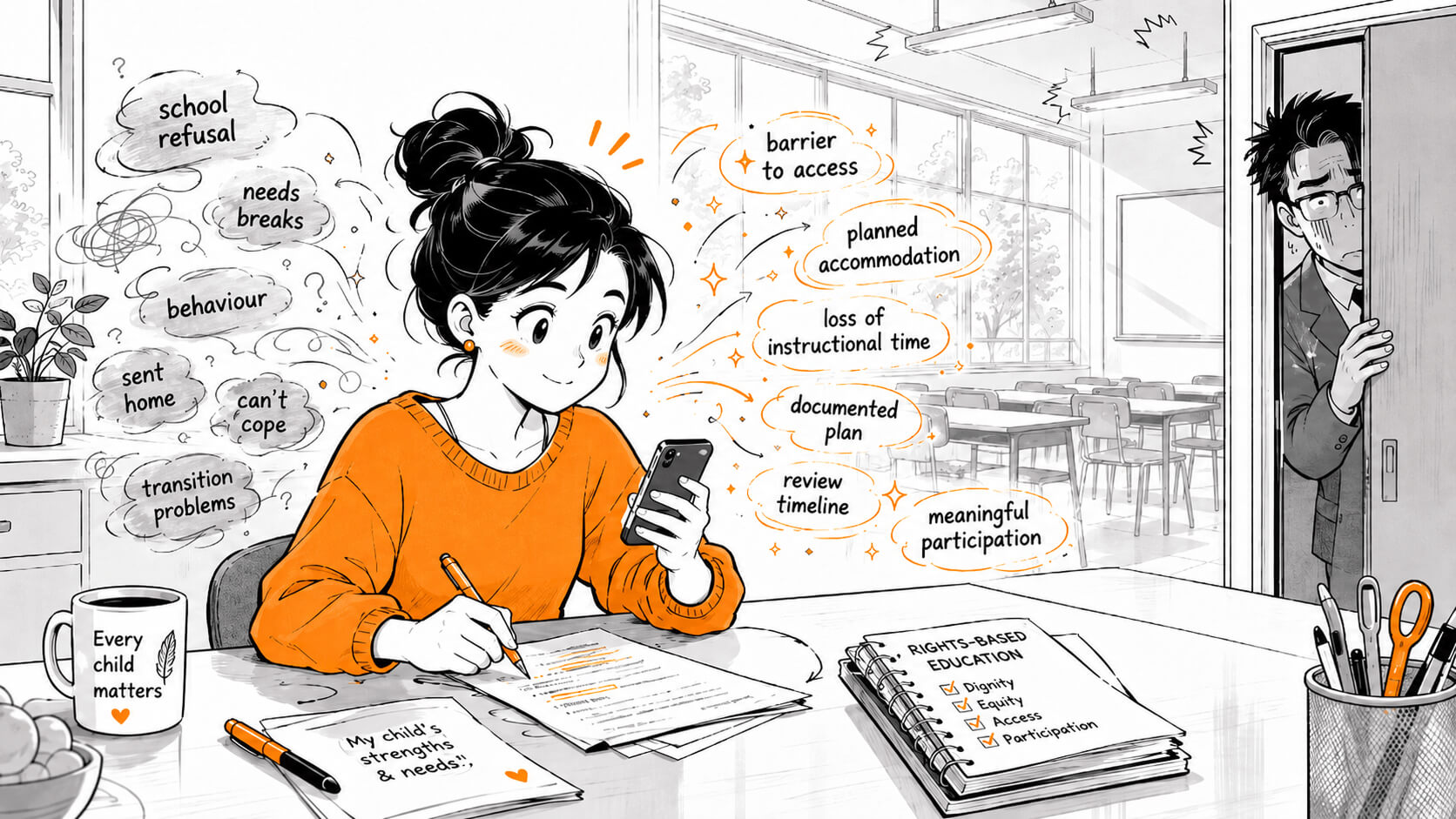
Families are often told to explain school concerns in softer, simpler, or more “collaborative” language. But when a disabled child is losing access to education, vague wording can make it easier for the real issue to disappear.
A parent might say, “My child needs more help,” “my child cannot handle transitions,” or “my child keeps getting sent home.” Those statements may be true, but schools may respond as though the issue is behaviour, staffing, parenting, flexibility, or a child needing to try harder.
Rights-based language helps name the barrier more clearly.
It connects what is happening to access, accommodation, safety, dignity, participation, and lost instructional time. It does not mean parents need to sound legalistic. It means describing the problem in a way that keeps the focus where it belongs: what does this child need in order to safely and meaningfully access school?
We have added a new resource:
Unlocking rights-based language for school advocacy
The guide walks through common phrases families may use in school meetings and offers clearer rights-based alternatives. It includes examples related to EA support, transitions, school avoidance, repeated removals from school, regulation breaks, friendship and belonging, sensory overwhelm, disability-related behaviour, discipline, and modified schedules.
For example, instead of saying:
“My child keeps getting sent home.”
The guide suggests naming the access issue more directly:
“My child is losing access to education through repeated removals from school. If the school believes they cannot safely support my child for the full day, we need a written plan identifying the barriers, the accommodations being provided, the criteria for increasing attendance, and the review timeline.”
Families should not have to use perfect language to receive support. Schools and districts have their own duty to recognise disability-related needs and respond appropriately. But in practice, clearer wording can help prevent concerns from being minimised, reframed, or delayed.
This resource is for parents and caregivers who are trying to stay anchored in hard conversations, especially when meetings start drifting toward personality, behaviour, staffing, patience, or tone.
Read the full guide here: