
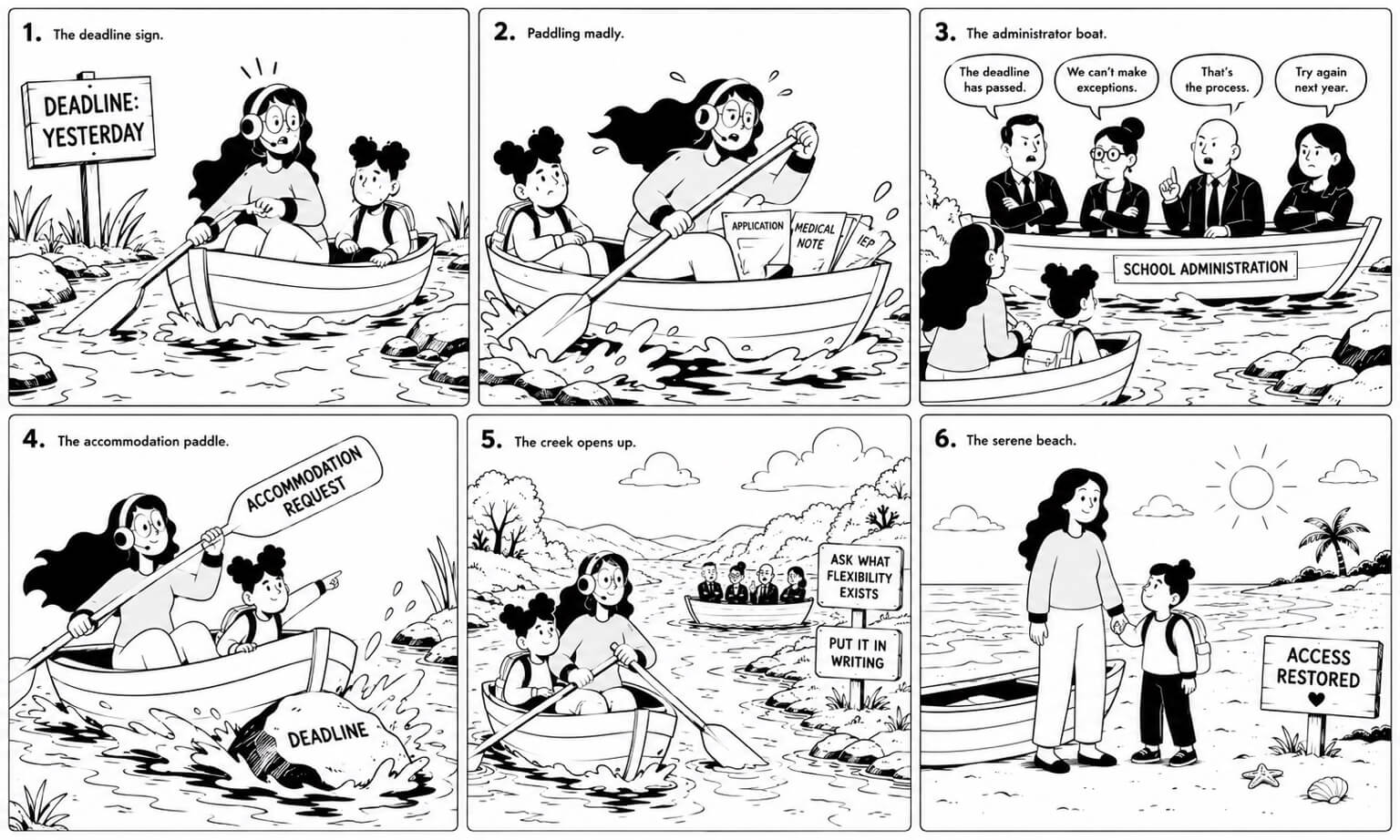
Short answer: no
Probably not.
If your child is disabled, designated, or has disability-related support needs in a BC public school, a missed deadline is not automatically the end of the road.
A school or district may say:
The deadline has passed.
The matter is closed.
We cannot make exceptions.
But an administrative deadline does not automatically override a child’s right to access education without discrimination.
The real question is:
Is enforcing this deadline creating a disability-related barrier to your child’s access to education?
If the answer is yes, you can ask the district to consider flexibility as an accommodation.
Accommodation often means changing the rule
Accommodation is not special treatment. It is the process of changing a rule, practice, deadline, environment, or expectation when the standard approach creates a barrier connected to disability.
Schools already do this every day.
For example, accommodation may include:
- modified assignments
- alternative assessments
- adjusted schedules
- sensory breaks
- assistive technology
- different communication methods
- support plans
- changes to attendance expectations
- changes to timelines
That is what accommodation means. It recognises that standard rules do not work equally for every student.
So when a district says an administrative deadline cannot be considered flexibly, the question is not simply whether the deadline exists. The question is whether applying it rigidly creates a discriminatory barrier.
Deadlines are planning tools, not access barriers
Most school deadlines exist for a practical reason. They help staff plan transportation, staffing, supplies, placements, supervision, course schedules, and programme numbers.
That matters. Families should try to meet deadlines when they can.
But deadlines are usually administrative tools. They are not supposed to become barriers that block a disabled child from education, services, or participation.
Schools and districts already adjust timelines in many ordinary situations:
- a field trip form comes in late
- a family misses a sign-up sheet
- a student enrols after staffing projections are complete
- a family moves into the district over the summer
- a school changes a placement plan
- a programme has unexpected space
- staff gave the family unclear or incorrect information
Flexibility exists. The issue is whether the district is willing to apply it when the reason is disability-related access.
The child is the point
This is not about families ignoring deadlines or expecting schools to chase them.
It is about situations where the deadline was missed because of something connected to access, disability, communication, or district conduct.
For example:
- the family was not told about the deadline
- staff gave incorrect or incomplete information
- the family was told not to worry about it
- the child was in crisis
- the parent was managing disability-related caregiving demands
- the parent has their own disability-related barriers
- the process was unclear, inaccessible, or poorly communicated
- the family was waiting for medical, assessment, or school information
- the school knew the child needed support but did not help the family navigate the process
In those situations, the deadline is not the whole story.
The child’s access to education is the point.
What the law says
Under section 8 of the BC Human Rights Code, students have the right to access services customarily available to the public without discrimination based on disability. Education falls within that service-access framework.
Under the School Act, a school-aged resident student is entitled to enrol in an educational programme, and boards must make an educational programme available to school-aged students who enrol in the district.
In Moore v. British Columbia (Education), the Supreme Court of Canada confirmed that the legal issue is meaningful access to the general education available to all students. Special education supports are not a bonus; for some disabled students, they are the means of accessing education.
That does not mean every late request must be granted exactly as asked. It does mean the district should not treat a deadline as the end of the analysis when disability-related access is at stake.
When the district caused you to miss the deadline
This part matters.
Sometimes families miss deadlines because they relied on what school or district staff told them.
For example, staff may have said:
You do not need to apply.
We will handle that.
Do not worry about the form.
That deadline does not apply to your child.
Wait until the IEP meeting.
We will talk about it later.
There is no point applying.
If you relied on that advice and then the district later says you are too late, say so clearly.
This may support an argument that it would be unfair or unreasonable for the district to enforce the deadline strictly, especially if the district’s own communication created the problem.
Write down what happened
Make a quick record while it is still fresh.
Include:
- who spoke to you
- their role
- what they said
- when they said it
- whether it was verbal, email, text, meeting, or phone
- what you did because of that information
- how the missed deadline now affects your child
Then put it in writing to the district.
You can say:
We were advised by [name/role] on or around [date] that [specific advice]. We relied on that advice. We are now being told the deadline has passed. Given the district’s role in creating this situation, and given the disability-related impact on our child’s access to education, we are requesting that the deadline be considered flexibly as an accommodation.
A May “no” is not always a September “no”
Districts often present spring deadlines as final.
But schools change over the summer.
Placements shift. Families move. Staffing changes. Enrolment numbers change. Programmes are reorganised. Some students who were expected to attend do not attend. Other students arrive late.
So if you are told in May or June that something is impossible, keep advocating.
Follow up again:
- near the end of June
- in late August
- during the first week of September
- whenever new information becomes available
A June refusal may not reflect what is actually possible once September planning becomes real.
What to do right now
1. Do not accept “the deadline has passed” as the final answer
Respond in writing.
Say that your child has disability-related access needs and that enforcing the deadline creates a barrier.
Use the word accommodation.
For example:
I am requesting flexibility with this deadline as a disability-related accommodation.
2. Explain the access impact
Do not focus only on the paperwork.
Explain what happens to your child if the district refuses flexibility.
For example:
- my child will lose access to a needed programme
- my child will be excluded from a school activity
- my child will miss a support needed for attendance
- my child will be placed in an unsafe or inappropriate setting
- my child will lose access to peers, routine, communication support, medical support, or disability-related planning
Make the harm concrete.
3. Go to the person with authority
The first person who says no may not have authority to fix the problem.
Consider writing to:
- the principal
- the district inclusive education lead
- the assistant superintendent
- the superintendent
- the secretary-treasurer, if transportation or fees are involved
- the board, if you are starting a formal appeal route
Keep the tone clear and factual. The goal is to get the issue in front of someone who can actually waive, reconsider, or solve the problem.
4. Ask for a written decision
Ask the district to put its answer in writing.
You can say:
Please provide the district’s written decision, including the reason the deadline cannot be applied flexibly in this disability-related access situation.
This matters because vague verbal refusals are hard to challenge. A written decision creates a record.
5. Set a short timeline
Do not let the issue drift.
You can say:
Given the impact on my child’s access to education, I am requesting a written response within five business days.
If school is about to end, summer is approaching, or the child’s placement is at risk, say that directly.
6. Name the next step
You do not need to sound threatening. You can simply identify the process you may use if the district refuses to resolve it.
Depending on the issue, possible routes may include:
- a district complaint process
- a section 11 appeal under the School Act, if a decision significantly affects the student’s education, health, or safety
- a complaint to the BC Human Rights Tribunal
- a complaint to the BC Ombudsperson
- a request for Ministry involvement, where appropriate
Section 11 appeals can apply where an employee decision significantly affects a student’s education, health, or safety, and “decision” can include a failure to make a decision.
A simple script
You can adapt this:
I understand the district’s position that the deadline has passed. However, my child has disability-related access needs, and enforcing this deadline without considering flexibility creates a barrier to their access to education.
I am requesting that the district consider a late application/late request as an accommodation.
The reason the deadline was missed is [brief explanation]. The impact on my child is [brief explanation].
Please provide a written response within five business days. If the district refuses to consider flexibility, please explain who made that decision, what information was considered, and why accommodation was denied.
The principle underneath all of this
A school deadline is supposed to help the district plan education for students.
It is not supposed to become a wall that blocks a disabled student from education.
When a deadline creates a disability-related barrier, the district should consider whether flexibility is required. That does not guarantee the exact outcome the family asks for. But it does mean the district has to engage with the access issue, not hide behind the calendar.
The question is not simply:
Did the family miss the deadline?
The better question is:
What does the child need to access education, and can the district reasonably adjust the process so that access is protected?
That is the argument to make.