
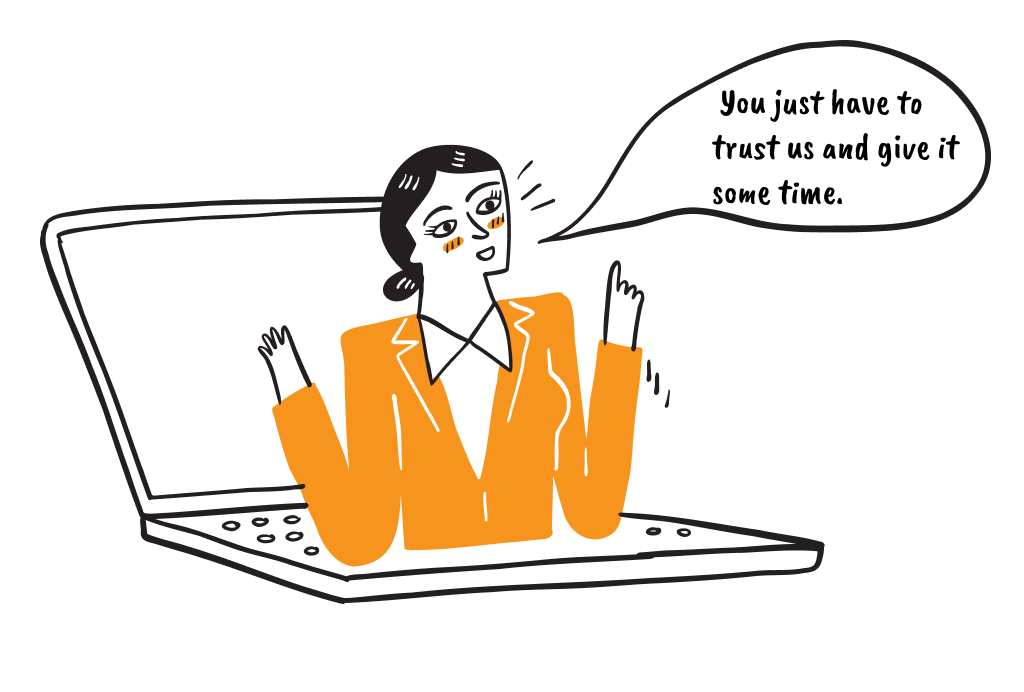
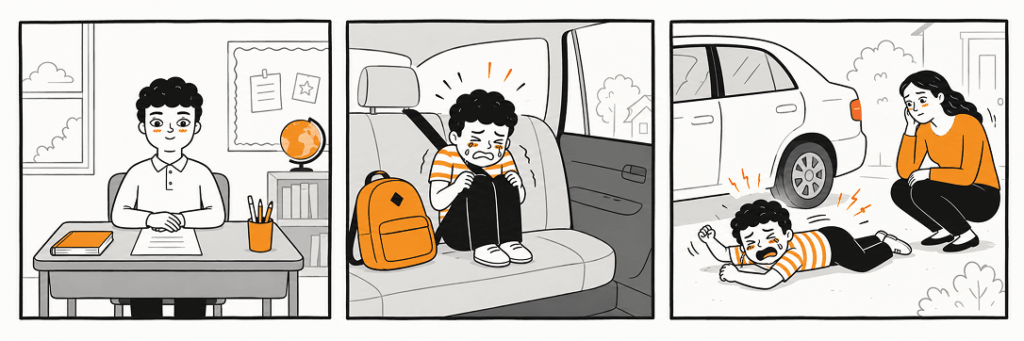
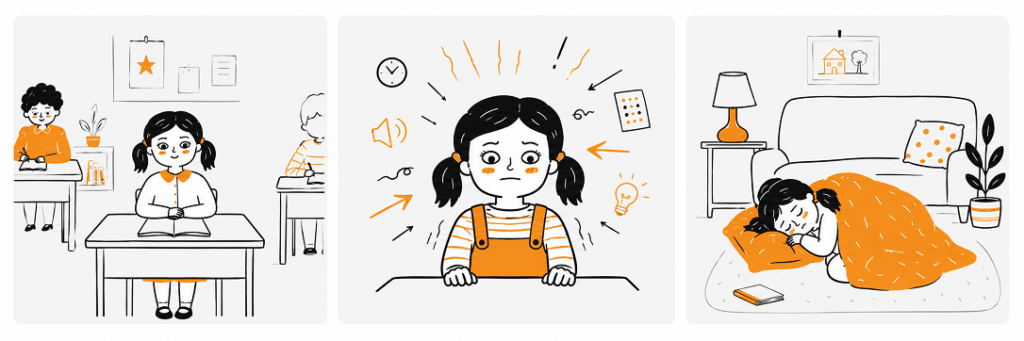
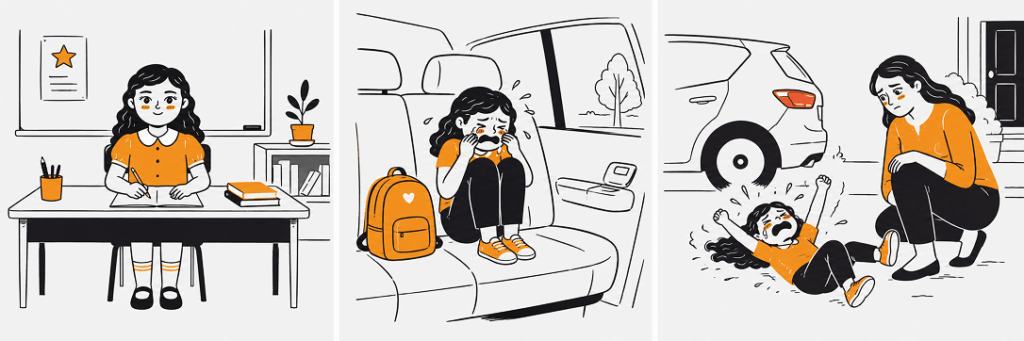
It’s common for a child to appear “fine” (or even unusually quiet, compliant, and capable) in the classroom—and then unravel after school with crying, anger, shutdown, or explosive behaviour at home. Clinicians and parent-support organisations often describe this as a release after sustained effort to meet expectations in a high-demand setting—sometimes called “restraint collapse.”
Two points matter for complaint/advocacy contexts:
- First, “fine in class” is an observation about what adults can see in that environment—not a measurement of whether the child is safe, regulated, learning well, or thriving. See Why Are Kids Different at Home and at School?
- Second, home meltdowns don’t automatically prove something “bad” happened at school; they can also reflect the child using every ounce of self-control all day and finally letting go where they feel safest. See Restraint collapse: Why kids fall apart after school
The hidden cost of holding it together all day
School is not just academics; it is sustained performance in a dense social environment with constant demands: transitions, noise, peer dynamics, adult directives, time pressure, sitting still, handwriting, listening, turn-taking, and coping with correction or evaluation. Many children can meet those demands—until the moment they can’t.
Research on emotion regulation helps explain why “good behaviour” can be expensive. Suppressing emotions doesn’t necessarily reduce internal stress; it can increase physiological activation (e.g., sympathetic nervous system activity) even when the child looks calm on the outside.
The stress literature offers a parallel framing: the body is built to adapt (allostasis), but frequent or prolonged activation—especially without enough buffering support—creates “wear and tear” (allostatic load). In children, chronic stress exposure is associated with downstream effects on learning- and behaviour-related functioning.
A key implication for “fine in class” claims: a child can be successfully suppressing visible distress while still accumulating cognitive, emotional, and physiological strain—and that strain may show up later, after the school day ends.
Safety and belonging are not “extras” for learning
Modern developmental science and education research increasingly converge on a basic point: brains learn best when the learner feels safe enough to engage, make mistakes, ask questions, and be socially included. Trauma-informed frameworks explicitly treat felt safety and support as prerequisites for readiness to learn.
The stress-and-development literature similarly emphasises that supportive relationships buffer children’s stress response systems, supporting healthier development and resilience.
Belonging is not only a moral value; it has measurable associations with outcomes. A meta-analytic review in secondary education found that school belonging is positively associated with favourable student outcomes, including engagement and achievement (with a small positive association specifically for achievement).
Social threats can also affect cognitive performance in concrete ways. For example, experimental work suggests that social exclusion can affect working memory performance in young adolescents—one of the core cognitive capacities students rely on to hold instructions in mind, follow multi-step tasks, and learn in real time.
In other words: if a child’s “fine” presentation is built on avoiding attention, avoiding mistakes, staying invisible, or appeasing adults/peers to prevent social risk, that may preserve external order while still undermining belonging, cognitive bandwidth, and long-term wellbeing.
When calm is a stress response: fight, flight, freeze—and appease
Parents often look for distress in the form of outward agitation. But the threat-response repertoire is broader than “fight or flight.” Human defensive responding can include freezing/tonic immobility—a state characterised by inhibition (reduced movement/vocalisation) that can occur when escape or fighting feels impossible or unsafe.
Traumatic stress researchers have proposed “defense cascade” models in which a person’s responses shift based on perceived danger and perceived options (e.g., moving through stages that can include freeze, flight, fight, and more shutdown-like states).
In everyday school life, this can translate into patterns adults misread as “fine,” such as:
- quiet compliance that masks panic or shame,
- perfectionism and over-control that hides overwhelm,
- good student presentation built on constant monitoring of adult moods,
- silence or dissociation-like zoning out that looks like calm.
There’s also a well-supported idea that humans may cope with threat by seeking affiliation and connection—an alternative behavioural pattern to pure fight/flight. The “tend-and-befriend” model proposes that, in some contexts, stress responding is marked by protective nurturing and social-network seeking as a way to promote safety and reduce distress. This offers a research-grounded bridge to what many families describe as “fawning/appeasing”: staying safe by pleasing, blending in, or not causing trouble.
A practical translation: a child can be regulated enough to comply without being regulated enough to learn or feel well.
Why schools may not see the problem, especially for neurodivergent kids
Here are a few of the reasons staff in BC schools may fail to recognise or minimise children’s suffering:
Observation limits and “context split”
- Schools have a constrained window: a teacher sees one child among many, often during structured time, and often prioritises whether the classroom runs smoothly. Home is different: fewer performance demands, less pressure to mask, and more proximity to attachment figures. That alone can produce dramatic setting differences.
- A particularly illuminating attachment example: the Canadian Psychological Association notes that some children can appear outwardly unaffected while physiological measures show they’re actually upset—an important reminder that “not showing it” is not the same thing as “not feeling it.”
Masking/camouflaging and internalizing distress
- For autistic children and adolescents, “camouflaging” (masking autistic traits in social situations) can be a barrier to adults noticing support needs. A large study of autistic youth found that camouflaging predicted internalising symptoms (e.g., anxiety, depression, somatic complaints), even when controlling for age, gender, and IQ—precisely the kind of distress that may not be obvious to teachers focused on external behaviour.
- This helps explain the recurring family report: “They’re ‘fine’ at school; then they collapse at home.” In many cases, the child’s school presentation is an adaptation to social demands, not evidence of comfort or capacity.
Discipline climate and perceived fairness
- Even when a school isn’t using overtly harsh tactics, students’ perceptions of unfair discipline correlate with worse mental health and risk outcomes in large-scale survey research—showing how the relational and fairness climate matters, not only the academic one.
Colonial and compliance legacies: why “obedience” is often treated as success
Schooling is historically tied to colonial governance and enforced compliance. Authoritative public history sources describe the residential school system as an assimilation policy imposed on Indigenous peoples, resulting in intergenerational harm and cultural genocide.
The schooling apparatus extended beyond residential schools. Library and Archives Canada describes federal Indian day schools as a colonial system used to forcibly assimilate First Nations, Inuit, and Métis children, designed to erase language, culture, and identity, and notes that children could be subjected to abuse and neglect even though they did not live at the schools.
On the broader “compliance culture” point, historical scholarship on Canadian schooling argues that state schooling developed as a system of regulation and normalisation, with expectations that children would “obey and conform” to schooling as an agent of socialisation and “Canadianization.”
Systems built to reward order can confuse quiet compliance with wellbeing, and can treat a child’s distress as secondary to instructional flow—especially when resources are scarce and visible disruption is the metric that triggers help.
What the research supports doing when the school says “fine”
Collaborative problem-solving can still be firm advocacy. The research above supports shifting the conversation from “Is my child disruptive?” to “What is this costing my child?”
In British Columbia, the provincial inclusive education policy explicitly frames inclusion as equitable access and meaningful participation—not just physical placement—and includes expectations around planning (including IEP requirements in many circumstances) and consultation with parents.
A research-aligned “next step” set looks like this:
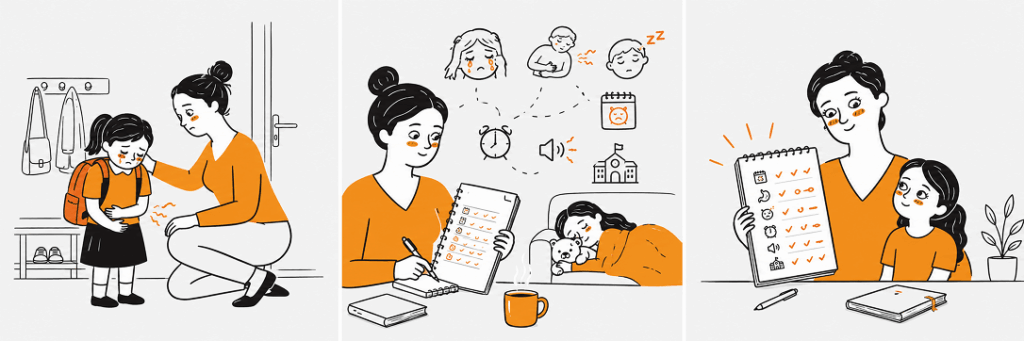
- Document the pattern (not just incidents): time of day of meltdowns, triggers (transitions, homework, social exhaustion), somatic complaints, sleep changes, school refusal signs, and recovery time.
- Ask for observation that goes beyond “no incidents”: specifically request information about peer interactions, transitions, noise/lunch/recess, task initiation, avoidance, perfectionism, shutdown, and whether the child is asking for help or staying invisible.
- Request supports that reduce load before behavior escalates: predictable transitions, sensory/regulation breaks, access to a quiet space, alternative demonstration of learning, reduced copying/handwriting demands, and a plan for post-recess/post-lunch regulation. These align with a “readiness to learn” framing rather than “discipline.”
- Treat “fine at school” + “falling apart at home” as a valid data discrepancy: it may indicate masking, internalising distress, or a freeze/appease pattern—not that the home environment is the cause.
What to say in a complaint
Under the British Columbia Human Rights Code, schools have a duty to ensure that students with disabilities can access education without encountering barriers related to their disability. That duty includes providing accommodations that support meaningful participation, not simply physical presence in the classroom.
Looking at the full pattern across settings — what happens at school and what happens after school — can help determine whether the environment is truly working for a child.
If you are writing a complaint or raising concerns, it can help to frame the issue in a way that acknowledges what staff are seeing while explaining the full picture. You might write something like this:
I understand that staff may not be seeing significant disruption in the classroom, and I appreciate the observations being shared about how my child appears during the school day.
At the same time, we are seeing significant distress after school that suggests the day may be taking more out of them than is visible in class. It is common for children to hold themselves together in structured environments and release that stress later in a place where they feel safe.
For that reason, the absence of visible disruption during the school day should not be interpreted as evidence that the learning environment is working well for them. The pattern we are seeing suggests the current environment may be creating barriers to their ability to participate comfortably and sustainably in school.
As you know, schools have a responsibility to ensure students with disabilities have equitable access to education and to provide accommodations that support meaningful participation. I would appreciate the school working with us to look at the full pattern across settings and consider whether additional supports or adjustments may be needed.
You do not have to navigate this alone. Several organisations in British Columbia provide information and support to families advocating for children with disabilities:
- Inclusion BC — information and advocacy support for families of children with developmental disabilities
- Family Support Institute of BC — peer support from other families navigating similar systems
- BCEdAccess Society — resources and legal information about inclusive education and students’ rights
Speaking with an advocate can help clarify what supports schools are legally required to provide and what options families have when those supports are not in place.
And if informal conversations are not resolving the issue, you can learn more about how to make a formal school complaint and what documentation helps support one at k12complaints.ca.