
Delay and denial tactics do not always look like refusal.
They often look like process.
They look like meetings, emails, consultation, care language, “trying strategies,” gathering more information, waiting for the next review, and saying the right things about inclusion.
This is why delay can be so hard to fight. Each step may sound reasonable on its own. Another meeting may sound reasonable. More information may sound reasonable. Monitoring may sound reasonable. Collaboration may sound reasonable.
But if your child continues to lose access to school, the process is not working.
In rights-based advocacy, the central question is:
What barrier is preventing this child’s meaningful access to education, and what is being done to remove it?
That question matters because school processes can easily pull families away from the barrier. The conversation may become about behaviour, staffing, complexity, parent tone, consultation, documentation, or the next meeting.
Those things may be relevant. But they are not the centre.
The centre is ACCESS!
If the barrier remains, your child is still being denied meaningful access — even if the school sounds caring, busy, or procedurally active.
What are delay and denial tactics?
Delay and denial tactics are patterns that slow down, soften, redirect, or contain a parent’s concern without fixing the underlying barrier.
They can include:
- talking about effort instead of outcome
- asking for more time without interim support
- requesting more documentation without saying what decision depends on it
- using positive language to reduce urgency
- keeping families in informal resolution too long
- reframing harm as behaviour
- treating parent advocacy as a communication problem
- documenting meetings while leaving impact out
- suggesting exit instead of removing barriers
- presenting complexity as a reason action cannot happen
Some delays are caused by real workload, staffing shortages, or system pressure. Some are defensive. Some are strategic. Some are disorganised.
Parents do not usually need to prove which one it is.
The stronger question is whether the school knew, or should have known, that your child was facing disability-related barriers, and whether it responded in a timely and meaningful way.
Start with the barrier
A barrier is anything that gets in the way of a disabled person’s full and equal participation.
In school, barriers can come from:
- the physical environment
- sensory demands
- communication systems
- discipline practices
- classroom expectations
- school schedules
- staffing models
- attitudes and assumptions
- lack of support
- inaccessible learning materials
- unsafe peer environments
- policies or procedures
- delays in decision-making
A barrier is not always a staircase or a locked door. A barrier can be a practice, a belief, a timetable, a communication gap, or a repeated failure to adapt.
For parents, the key advocacy move is to translate school language back into barrier language.
| What the school may focus on | Barrier-focused reframing |
|---|---|
| “Your child refuses to come inside.” | What barrier makes entering the school feel unsafe or intolerable? |
| “Your child is not engaging.” | What barrier is preventing participation? |
| “Your child is dysregulated.” | What conditions are causing overload, fear, or loss of regulation? |
| “We need more time.” | What interim support will remove or reduce the barrier while you assess? |
| “We have tried strategies.” | Which barrier did each strategy address, and did access improve? |
| “This is complex.” | What is the plan to identify, remove, monitor, and adapt around the barriers? |
This matters because school processes can shift attention away from access. The conversation may become about behaviour, effort, staffing, tone, fairness, or process. Barrier language brings the conversation back to your child’s rights.
The school has to make meaningful inquiry
Parents need to tell the school what they know.
That might include a diagnosis, disability-related needs, anxiety, burnout, masking, school refusal, shutdowns, meltdowns, missed school, physical symptoms, or what happens before and after school.
You do not need to arrive with a perfect solution.
Once the school has enough information to know that disability-related needs may be involved, it should ask what is getting in the way of your child’s access.
That means the school should:
- identify possible barriers
- seek relevant information
- consider supports and accommodations
- act in a timely way
- provide interim support where needed
- monitor whether the plan is working
- adapt when the plan fails
A school does not meet this responsibility by saying:
- “We did not know exactly what to do.”
- “The parent did not provide a perfect plan.”
- “We tried some strategies.”
- “The child still struggled.”
- “We need more time.”
- “This is complicated.”
The duty is active. The school has to inquire, respond, monitor, and adjust.
Mechanisms of delay and denial
Delay and denial tactics are not always a single decision. Often, they are built into the process itself.
A family asks for support. The school asks for more proof. The parent provides documentation. The school says it needs more time. The child continues to miss school. A meeting is scheduled. The meeting produces another plan to “monitor.” The plan does not change the child’s access. The family asks again. The concern is reframed as complexity, behaviour, staffing, fairness, or process.
No one has clearly said no.
But the child still does not have access.
The following patterns can help families recognise when process is replacing remedy.
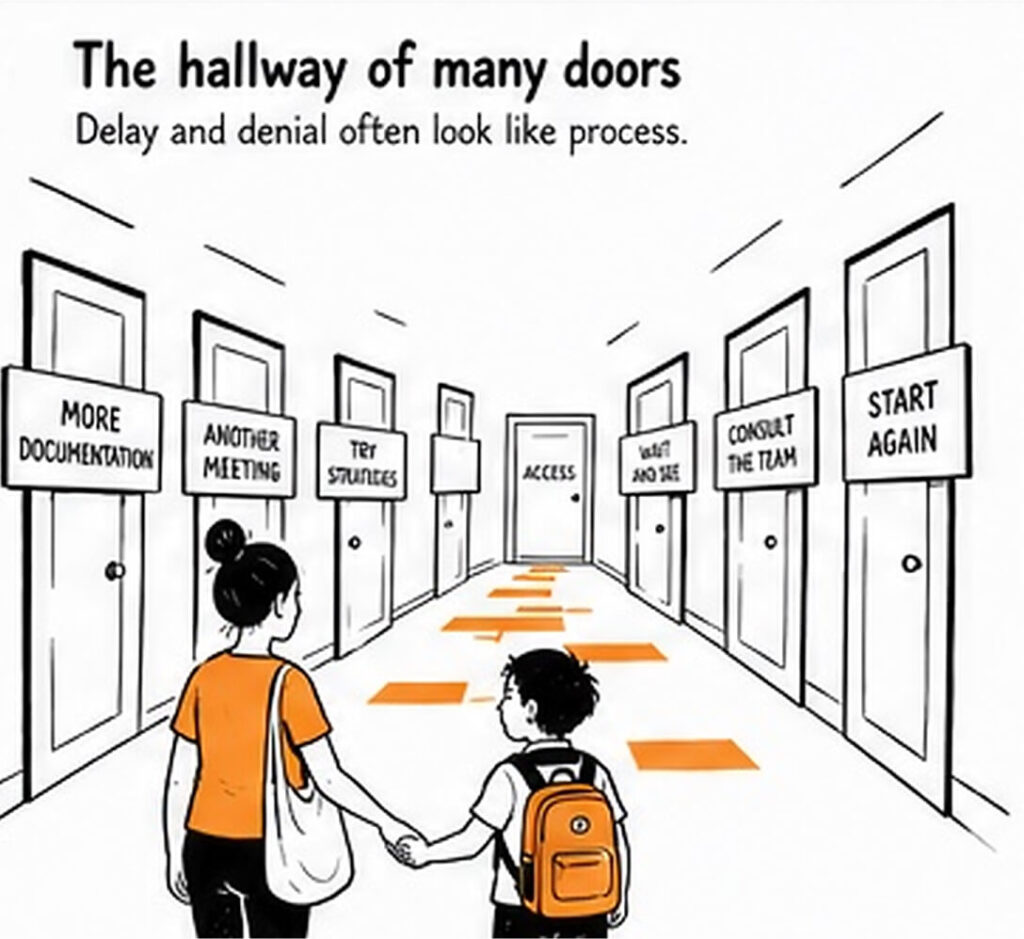
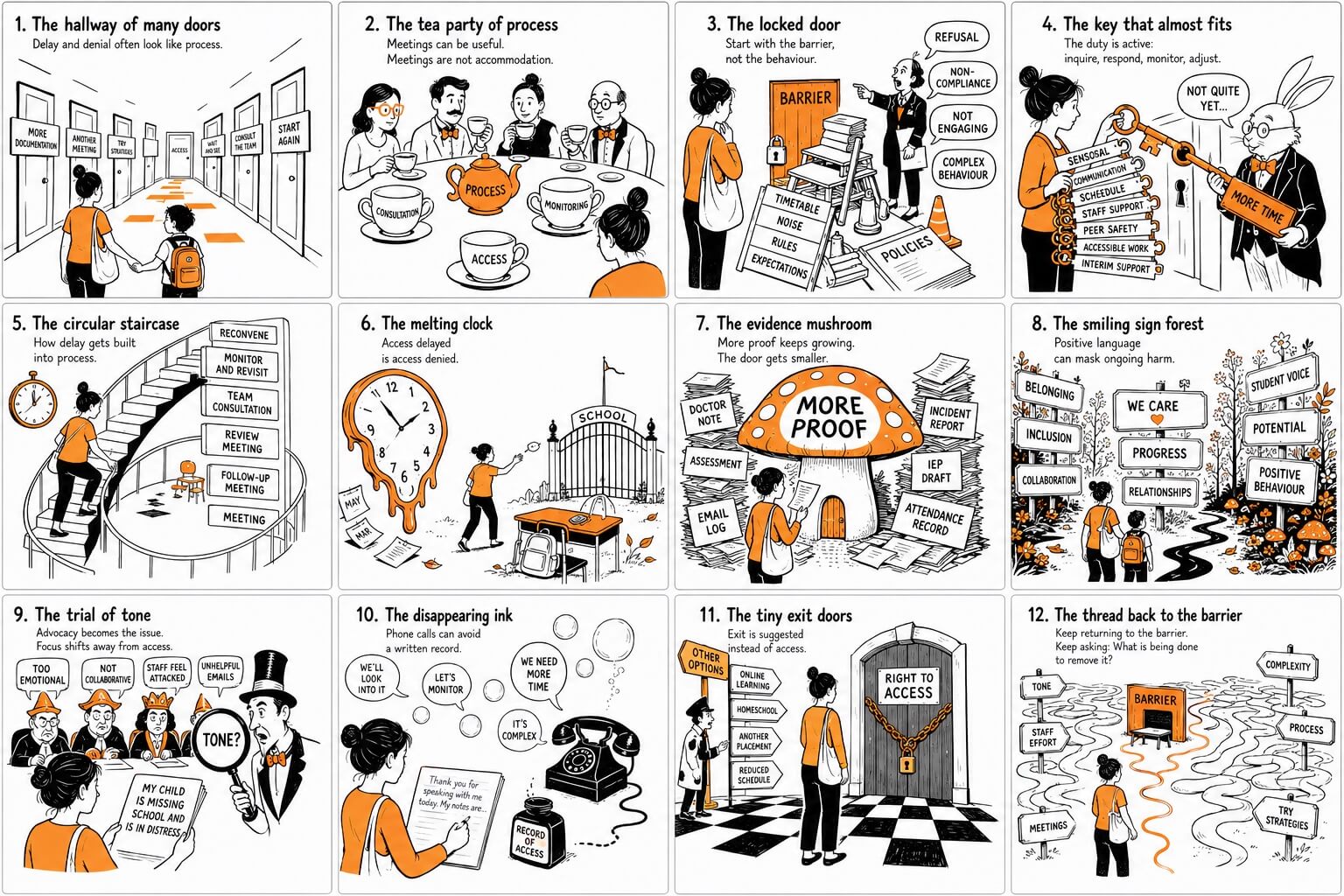
1. The hallway of many doors: process as diversion
A family may begin with one clear concern: their child is not safe, not supported, not attending, not included, or not able to participate.
Instead of addressing the barrier directly, the school process can multiply around the family.
The parent is sent through one door after another:
- more documentation
- another meeting
- another strategy
- another consultation
- another review
- another person to contact
- another place to start again
Each door may sound reasonable. The problem is the cumulative effect. The family spends their limited time and energy moving through process, while the child’s access remains unchanged.
A process is only useful if it moves the child closer to access.
Try asking:
I understand there are several process steps. Can you please confirm which barrier each step is meant to address, what will change for my child now, and when we will know whether access has improved?
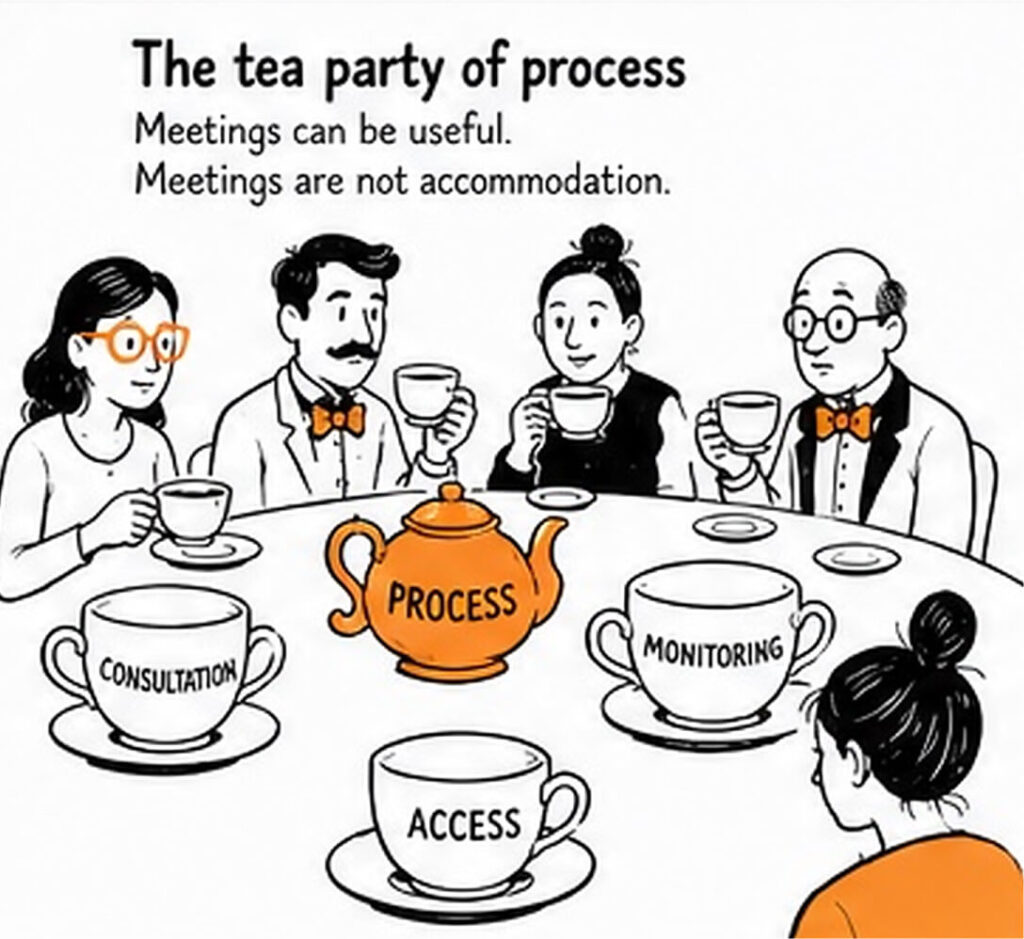
2. The tea party of process: meetings replace accommodation
Meetings can be useful. Consultation can be useful. Collaboration can be useful.
But meetings are not accommodation unless they lead to action.
A school may keep a family in a cycle of discussion while the child continues to miss school, attend part-time, experience distress, or remain unsupported in the same environment.
This can sound like:
- “Let’s meet again.”
- “We are still working through the process.”
- “We need to consult the team.”
- “We are monitoring the situation.”
- “We want to keep collaborating.”
Collaboration matters. But collaboration cannot become a holding pattern.
Try:
I am willing to meet. I would like the meeting to result in a concrete plan, including what will change, who is responsible, when it will happen, and when we will review whether access has improved.
A meeting is only useful if it produces a decision, a plan, a timeline, or a meaningful next step.
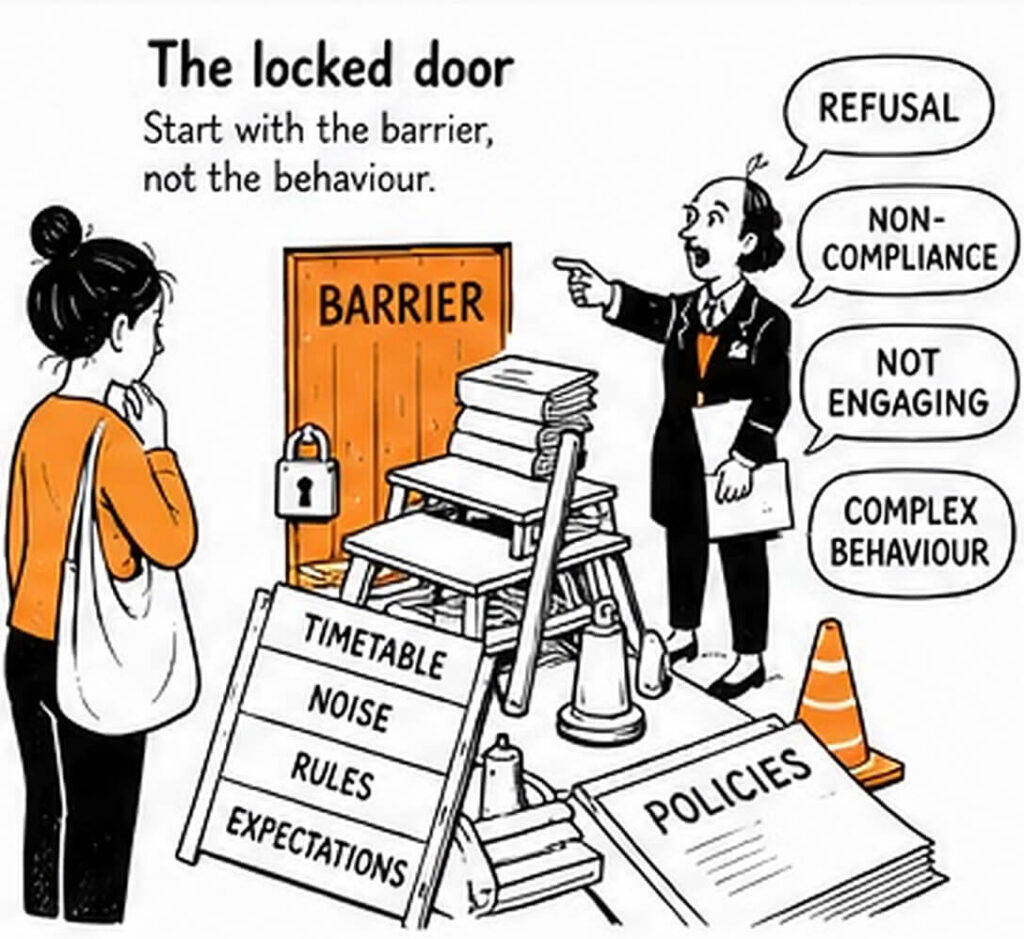
3. The locked door: behaviour replaces barrier
Schools often describe children through behaviour language.
This can sound like:
- “They are refusing.”
- “They are non-compliant.”
- “They are not engaging.”
- “They are dysregulated.”
- “They are unsafe.”
- “They are choosing not to participate.”
Behaviour may be real. It may be important information. But behaviour is not the end of the inquiry.
The question is what barrier, unmet need, or condition is contributing to it.
A child may be refusing because the environment feels unsafe. A child may be disengaging because the work is inaccessible. A child may be melting down because the sensory demands are overwhelming. A child may be “not attending” because the school has not made attendance possible.
Try:
My concern is not only the behaviour. My concern is the unmet need or barrier that is producing the behaviour. What barrier has been identified, and what will change?
Or:
I am asking that we focus on what is preventing access, not only how my child’s distress is being expressed and interpretted.
This shift matters. If the school focuses only on behaviour, the response may become control. If the school focuses on barriers, the response can become accommodation.
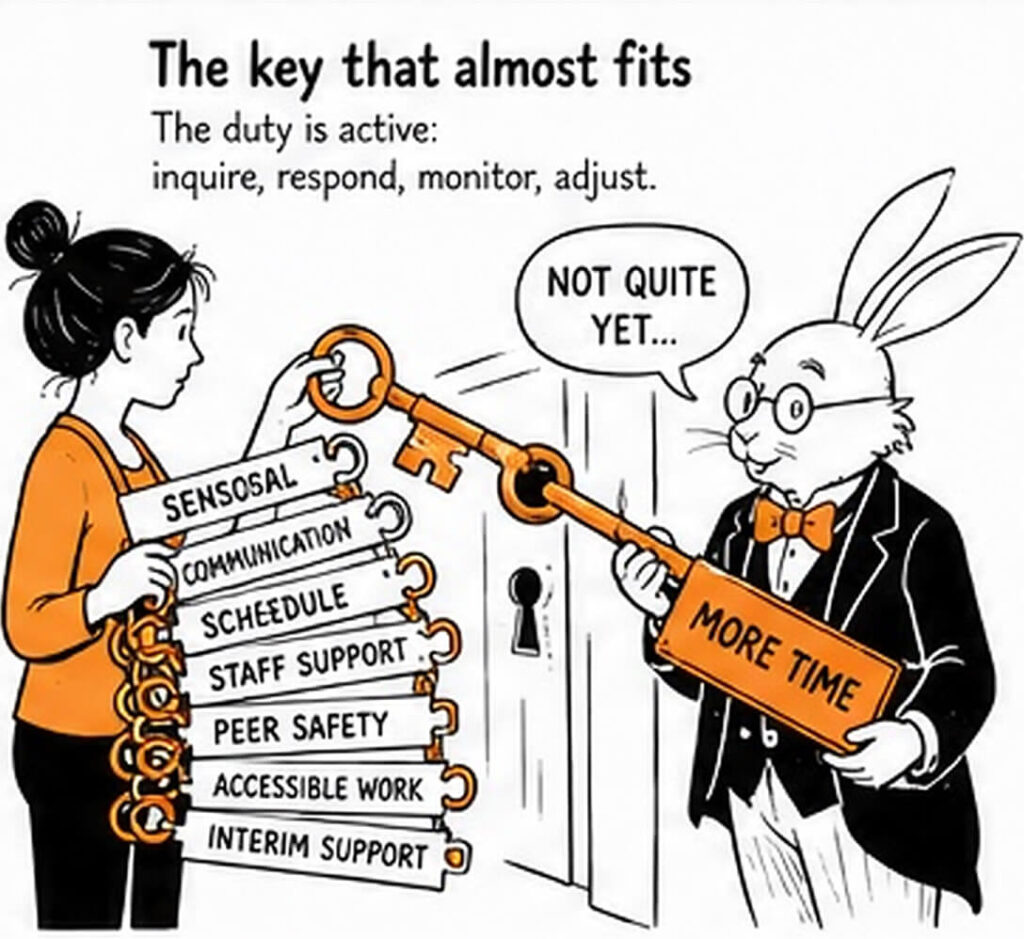
4. The key that almost fits: more time replaces meaningful inquiry
Sometimes the school says it needs more time.
That may be reasonable. Some situations are complex. Staff may need to consult, gather information, review records, or coordinate support.
But “more time” is not a plan.
More time becomes a delay tactic when there is no interim support, no deadline, no clear question being investigated, and no explanation of what will happen while the child waits.
This can sound like:
- “Not quite yet.”
- “We need more time.”
- “We need to understand the situation better.”
- “We are still gathering information.”
- “We need updated recommendations before moving forward.”
The duty to accommodate is active. The school does not need a perfect answer before it can provide support.
Try:
What support will be in place while the school gathers more information?
Or:
What specific question is the school trying to answer, what information is needed, and what is the deadline for the next decision?
The key question is not whether the school is still thinking. It is whether your child is still waiting without access.
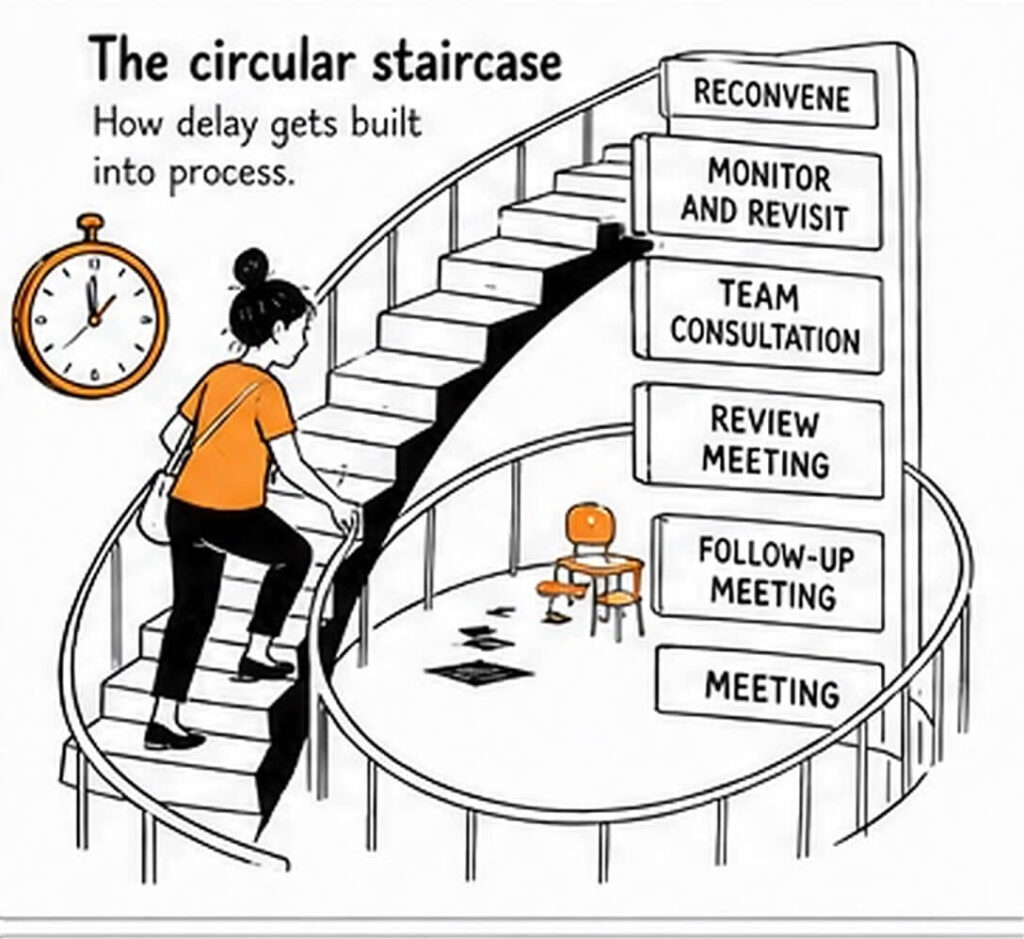
5. The circular staircase: the process loops back on itself
Sometimes delay feels like movement.
There is a meeting. Then monitoring. Then a review meeting. Then team consultation. Then another meeting. Then a new plan to monitor and revisit. You are working really hard and you keep doing it and your comforting your child after school and helping them recuperate to keep doing the routine.
The family is climbing, but they keep arriving at the same place.
This is how denial can work in practice. The system does not have to openly refuse. It can create enough steps, delays, discretionary decisions, and vague responses that the family runs out of time, money, energy, or hope.
The child’s access remains the measure.
Ask:
- What changed after the last meeting?
- Did the change improve access?
- What is different this time?
- What happens if the plan does not work?
- When will this be escalated?
Try:
We have had several meetings about the same access issue. I am asking for a written plan that identifies the barrier, the support being provided, who is responsible, and the date we will review whether my child’s access has improved.
A loop can look like movement while keeping the child in the same place.
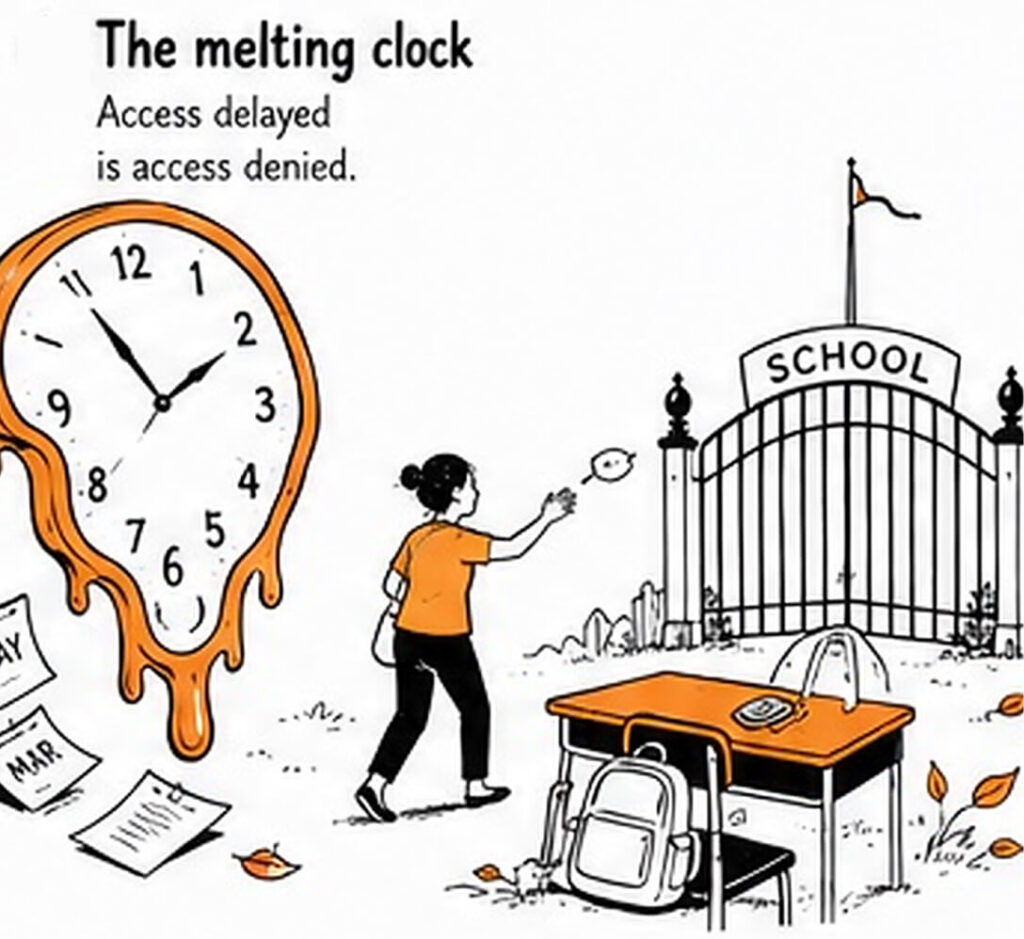
6. The melting clock: time is part of the harm
Delay is not neutral when a child is missing school, losing skills, becoming isolated, or deteriorating.
A delayed decision can still deny access.
A delayed meeting can still prolong harm.
A delayed assessment can still leave a child without support.
A delayed response can still push a family toward withdrawal, online learning, partial attendance, or crisis.
Time moves differently for a child. A few weeks can matter immensely when a child is not attending school, is losing trust, or is becoming more distressed.
When the school asks for more time, ask:
- What barrier are you investigating?
- What support will be in place while we wait?
- What is the deadline for the next decision?
- Who is responsible for the next step?
- What will happen if my child continues to miss school?
- How will we know whether access has improved?
A timeline does not have to be hostile. It makes the process real.
Not making a decision is still a decision when the child continues to lose access.

7. The evidence mushroom: documentation becomes a moving target
Sometimes more information is reasonable.
The school may need to understand a child’s needs, risks, triggers, strengths, communication, sensory profile, medical needs, or disability-related barriers.
But documentation requests can also become a moving target.
This can sound like:
- “We need more documentation.”
- “Do you have another assessment?”
- “Can you get a doctor’s note?”
- “Can you get updated recommendations from the occupational therapist?”
- “We need more information before deciding.”
The problem is not every request for information. The problem is open-ended information seeking that delays support without explaining what decision depends on it.
Try:
Please confirm what specific decision depends on this documentation, what question it is expected to answer, and what interim support will be provided while we obtain it.
You can also ask:
Is the school saying it cannot provide any support unless this documentation is provided? If so, please explain why in writing.
This helps prevent documentation requests from becoming delay.
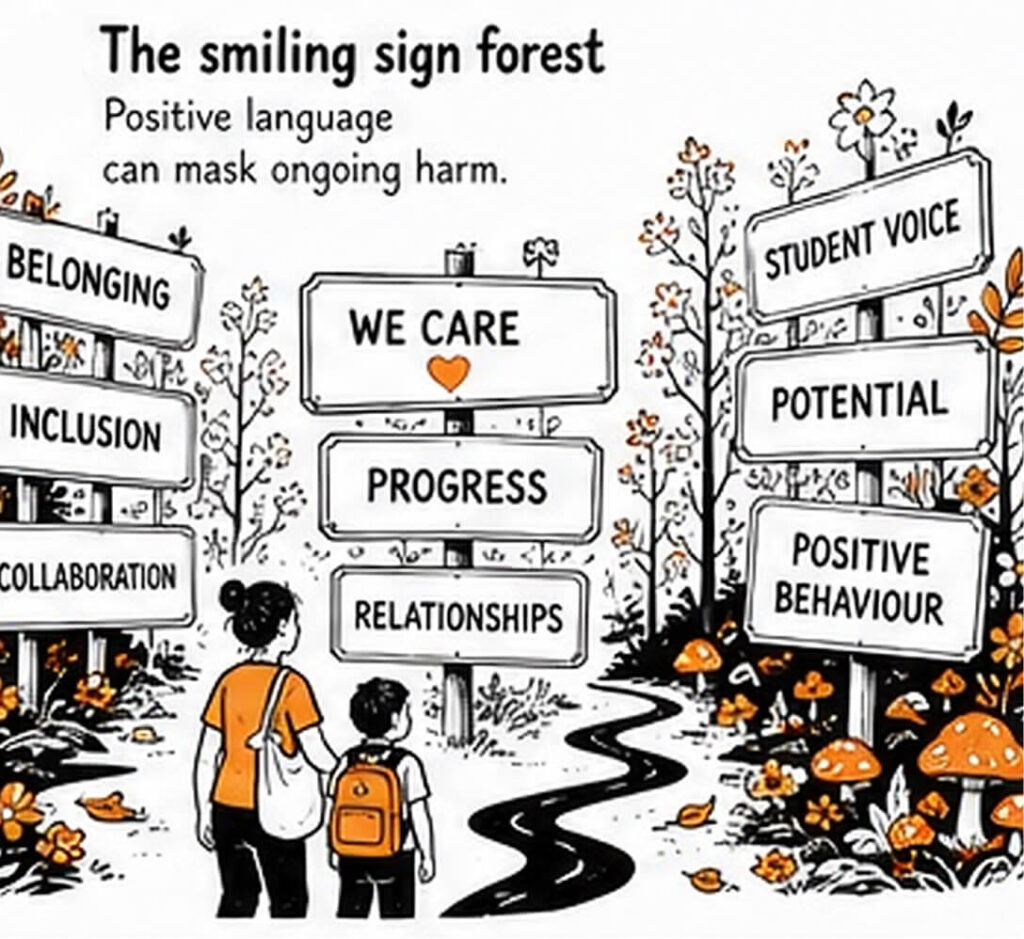
8. The smiling sign forest: positive language masks harm
Schools often use positive language.
They may say:
- “They are making progress.”
- “They had a better day.”
- “We are staying positive.”
- “They are doing well overall.”
- “We value belonging.”
- “We care deeply about inclusion.”
- “We want this to be collaborative.”
Some of this may be true.
The issue is whether positive language is being used to avoid documenting harm, urgency, or lack of access.
A child can have a better day and still be excluded. A child can make progress and still be unsupported. A school can use the language of belonging while a child remains on a reduced schedule.
Try:
I am glad there were some positive moments. The larger pattern remains that my child is missing school and showing serious distress at home. I need the record to reflect both.
Or:
I appreciate the school’s commitment to inclusion. I am asking what concrete changes will remove the barrier to my child’s access.
Positive language does not resolve a barrier.
Also see: Non-performativity: when saying the right thing replaces doing the right thing
9. The trial of tone: parent advocacy becomes the issue
Sometimes the focus shifts from the child’s access to the parent’s communication.
This can sound like:
- “Your tone is concerning.”
- “We need to keep this collaborative.”
- “Your emails are not helping.”
- “Staff feel overwhelmed by your communication style.”
- “You are being too emotional.”
- “This is making it harder to move forward.”
Respectful communication matters. But tone discussions can also redirect attention away from the school’s responsibility to respond to disability-related barriers.
A parent may be upset because their child is being harmed. A parent may be persistent because earlier concerns were ignored. A parent may sound urgent because the situation is urgent.
Try:
I am willing to communicate respectfully. I am asking that we keep the focus on my child’s access to education and the actions needed to restore access and remove barriers.
If needed:
I do not agree that my communication style changes the school’s responsibility to respond to disability-related barriers.
A parent’s tone does not erase the school’s duty.
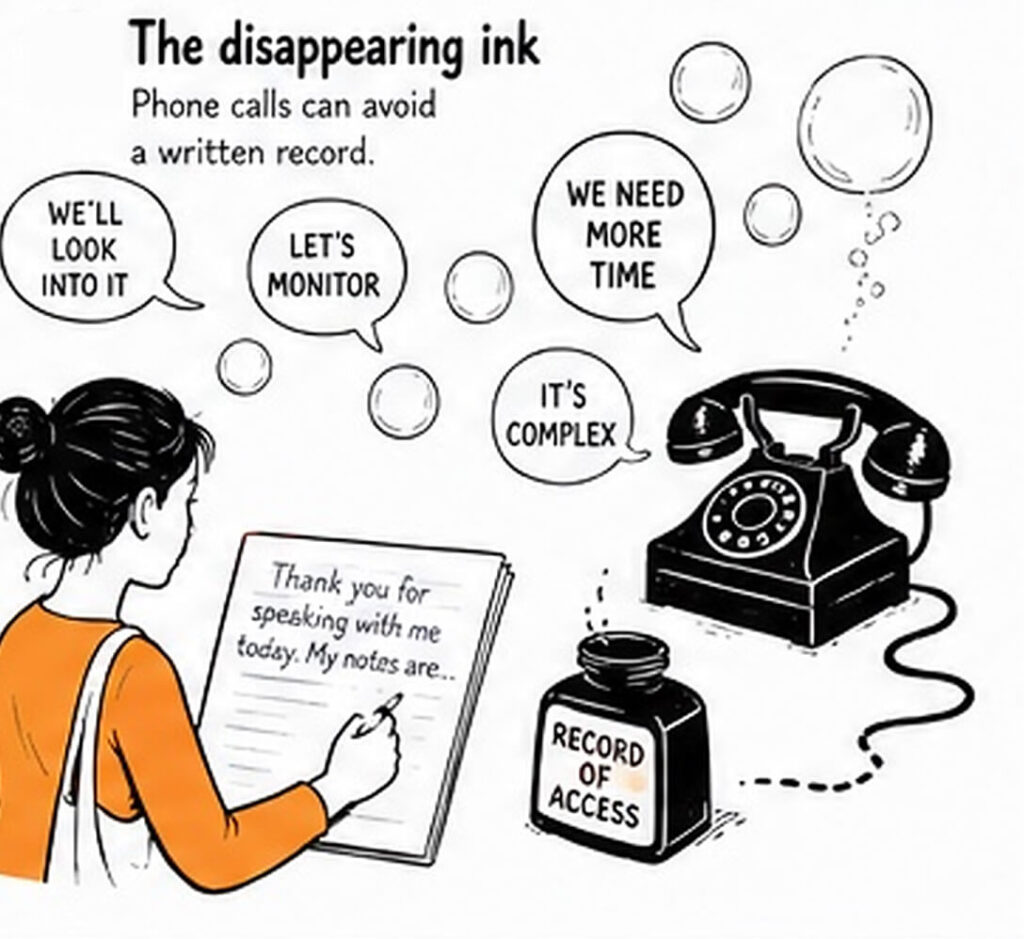
10. The disappearing ink: phone calls erase the record
Sometimes schools respond to written concerns by phone.
A phone call may be useful. It can reduce tension, clarify misunderstandings, and allow people to speak more naturally.
But phone calls can also avoid creating a written record.
If the issue matters, create one.
After the call, send an email:
Thank you for speaking with me today. My notes are that we discussed [summary]. I understand the next steps are [summary]. Please let me know if I have misunderstood or missed anything.
You can also say during the call:
I am taking notes so I can keep an accurate record.
That is reasonable. Documentation protects everyone.
If something was promised, record it. If something was refused, record it. If there was no clear answer, record that too.
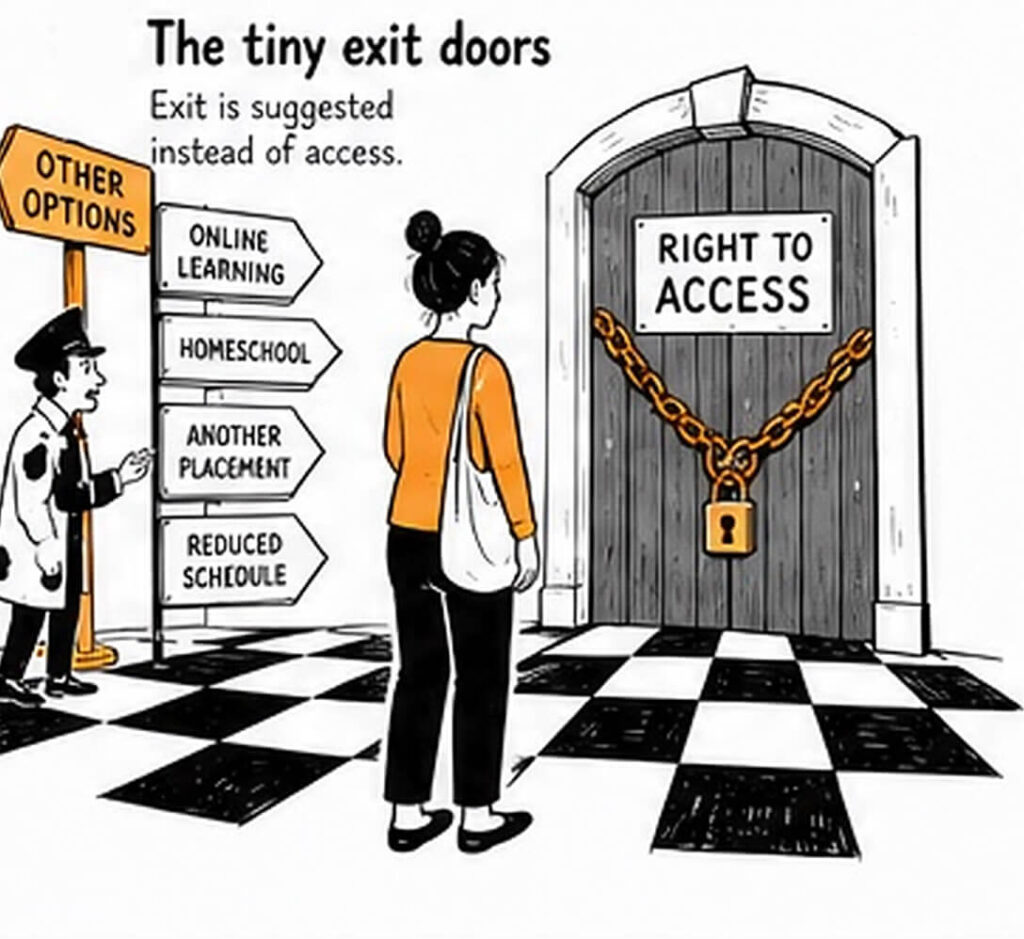
11. The tiny exit doors: exit is suggested instead of access
Sometimes a school suggests that a child should leave, reduce attendance, move online, homeschool, or attend another placement.
This can sound like:
- “Maybe this school is not the right fit.”
- “Online learning may be better.”
- “Have you considered homeschooling?”
- “Another placement might be more appropriate.”
- “Maybe they should attend for shorter periods.”
- “They may need a different environment.”
Sometimes a different placement is genuinely needed. Sometimes a reduced schedule is part of a short, documented transition plan. Sometimes families choose another option because it is the safest available choice.
But exit should not become the default solution to barriers the school has not addressed.
Try:
Before we discuss exit, I want to understand what barriers in this setting have been identified, what accommodations have been tried, and why the school believes those barriers cannot be removed.
Or:
I do not want reduced attendance to become a substitute for accommodation. What is the plan to restore meaningful access?
The child should not be made to leave simply because the system has not provided access.
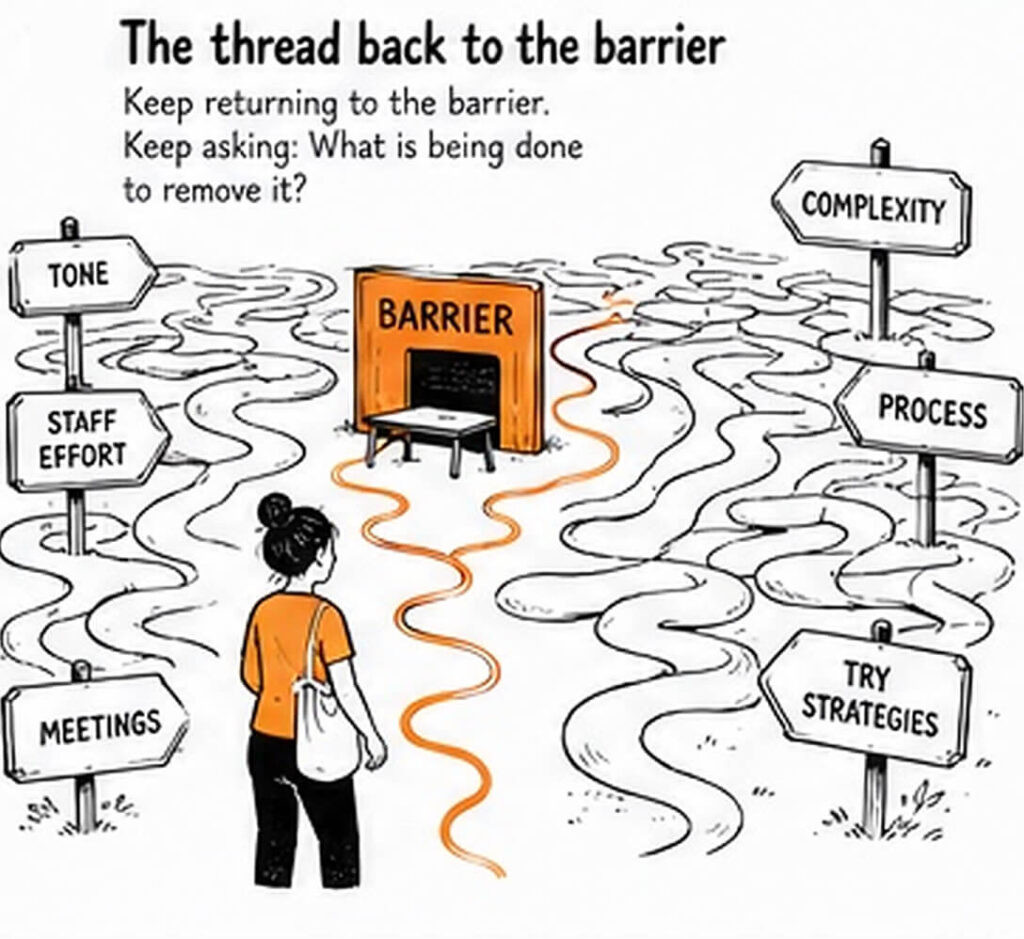
12. The thread back to the barrier: keep returning to access
Delay and denial tactics work by pulling the conversation away from the barrier.
The focus may shift to:
- parent tone
- staff effort
- complexity
- fairness
- process
- meetings
- more time
- more proof
- positive language
- trying strategies
Some of these issues may matter. But none of them should replace the core question.
What barrier is preventing access, and what is being done to remove it?
When the conversation wanders, return to the barrier.
Try:
I understand there are several issues being discussed. I want to return to the central access question: what barrier is preventing my child’s meaningful participation, and what is being done to remove it?
Or:
I am not asking whether people are trying. I am asking whether the barrier has been removed.
Do not chase every rabbit.
Follow the barrier.
What to document
Document both the barrier and the delay.
Track:
- dates your child missed school
- reduced days, late starts, early pickups, or partial attendance
- physical symptoms
- emotional distress
- loss of skills, friendships, routines, or confidence
- what your child says about school
- what you told the school
- when you told them
- what barrier you identified
- what support you requested
- whether the school responded
- what the school said it had tried
- whether the strategy improved access
- missed timelines
- unanswered emails
- requests for more documentation
- meetings that did not produce action
- any suggestion that your child leave, reduce attendance, or use another option
This helps show the difference between process and outcome.
A record that says “the school held meetings” is incomplete if it does not also show that the child remained excluded, unsafe, unsupported, or unable to attend.
What to ask in writing
When delay continues, send short, clear questions.
You can ask:
- What barrier has the school identified?
- What accommodation is being considered?
- What interim support is in place while decisions are pending?
- What is the timeline for a decision?
- Who is responsible for the next step?
- How will the school measure whether my child has meaningful access?
- What will happen if the current plan does not work?
- Please confirm whether the school is refusing the requested accommodation. If so, please provide the reasons in writing.
That last question is important.
Schools may avoid saying no clearly. A clear refusal can be escalated. A vague delay can keep families stuck.
When the school says nothing can happen yet
Schools often ask families to wait for:
- a school-based team meeting
- an IEP review
- a district consultation
- a specialist report
- a staffing decision
- a behaviour plan
- an assessment
- a placement conversation
- the next reporting period
Some of these steps may be necessary. But they do not answer what happens now.
What happens while your child is waiting?
Ask:
What will be in place while we wait?
This is the interim-support question.
It matters because the child’s right to access does not pause while adults organise process.
When to escalate
Escalation may be needed when:
- emails are repeatedly ignored
- meetings do not produce concrete change
- the child continues to miss school
- the school refuses to identify barriers
- timelines keep moving
- documentation requests keep expanding
- the school will not put decisions in writing
- the child is deteriorating while adults continue to “monitor”
- the same issue has been raised repeatedly
- the school suggests reduced attendance or exit instead of accommodation
Escalation does not mean you are refusing collaboration. It means informal collaboration has not produced access.
You can write:
I remain willing to work respectfully with the school. However, the current process has not restored my child’s access to education. I am escalating because the barrier remains and the harm is continuing.
Who to contact next
The right next step depends on the situation, but a common path is:
- teacher or case manager
- principal
- district staff, such as inclusive education, learning support, or senior district leadership
- school board complaint process
- Ombudsperson complaint
- Human Rights Tribunal complaint, where disability discrimination may be involved
- other complaint bodies, depending on the issue
When escalating, include the people who need to know. If you copy someone, do not assume they will respond. Usually, the person in the “To” line is the person being asked to act.
Use clear deadlines.
For example:
Please respond by [date]. If I do not receive a response, I will escalate this matter to [name or role].
For urgent safety or access issues, shorter timelines may be appropriate.
Keep the legal question clear
Parents do not need to prove that the school meant to delay, deny, or exhaust them.
The stronger question is whether the school knew, or should have known, that the child was facing disability-related barriers, and whether it responded reasonably.
That includes:
- meaningful inquiry into what was preventing access
- timely action to remove barriers
- interim support while decisions were being made
- monitoring to see whether the plan worked
- adaptation when the plan failed
- clear communication with the family
A school can be polite and still fail this duty.
A school can hold meetings and still fail this duty.
A school can say it believes in inclusion and still fail this duty.
The issue is whether the child gained meaningful access.
Sample email: request for a barrier-focused plan and timeline
Subject: Request for barrier-focused plan and timeline
Dear [name],
I am writing to follow up about [child’s name]’s access to education.
As I have shared, [child’s name] is currently experiencing [brief description: missed school, reduced attendance, distress, shutdowns, unsafe conditions, inability to participate]. I am concerned that this is connected to disability-related barriers at school.
At this point, I am asking the school to confirm:
- what barrier or barriers have been identified
- what accommodation or support will be provided now
- what interim support will be in place while any further assessment or consultation occurs
- who is responsible for each next step
- the timeline for action
- how we will measure whether [child’s name] has meaningful access to education
I understand that staff may be working hard and that the situation may be complex. My concern is that the current process has not restored [child’s name]’s access to education.
Please respond by [date].
Sincerely,
[name]
Key phrases parents can use
- I understand that staff have been trying. The barrier remains.
- What will change, by when, and who is responsible?
- What interim support will be provided while we wait?
- Please identify the barrier this strategy is meant to remove.
- Please confirm whether the requested accommodation is being refused.
- A meeting is only useful if it produces a plan, timeline, or decision.
- I am willing to communicate respectfully. I am not willing to continue a process that does not restore access.
- My child’s right to meaningful access does not pause while adults gather information.
- Access delayed is access denied.
Closing: is the barrier being removed?
Delay and denial tactics matter because they keep barriers in place while making the institution appear responsive.
The school may sound caring. The process may look active. The language may be positive. The meetings may continue.
But the question remains:
Is the barrier being removed?
If the answer is no, the concern has not been resolved.
Keep the focus there.
Related reading
These pages can help you understand the pattern you may be experiencing and decide what to do next. You do not need to read everything at once. Start with the page that matches what is happening right now.
If the school says the right things but nothing changes
- Non-performativity: when saying the right thing replaces doing the right thing: Start here if the school keeps saying it values inclusion, safety, belonging, or parent voice, but your child’s actual situation is not improving. This page explains how positive language can take up the space where action should be.
- Toxic positivity and harm masking in school processes: Read this if serious harm is being described in soft or hopeful language. For example: “They’re making progress,” “It was just a hard day,” or “Things are going well overall.” This page helps you name when reassuring language is making the problem harder to address.
If meetings keep happening but your child is still stuck
- Informal resolution: how parents get stuck in “working it out”: Read this if you are being asked to keep meeting, keep talking, keep collaborating, or keep trying school-level solutions, but nothing concrete changes. This page explains how informal process can become a holding pattern.
- The timeline: how to escalate a school complaint without losing it: Read this when you need to know what to do next. It helps you set deadlines, move up the chain, and avoid getting trapped in vague promises or endless meetings.
If the record does not show what is really happening
- Documentation asymmetry in school processes: Read this if the school’s records make the situation look calmer, smaller, or more resolved than it really is. This page explains why parents often need to document the child’s lived experience, not just respond to the school’s version of events.
- Why does the school keep asking for more documentation? Read this if the school keeps asking for another report, note, assessment, or form before it will act. This page helps you tell the difference between a reasonable request for information and a delay tactic.
If the school is focusing on your child’s behaviour instead of the barriers
- When harm is reframed as behaviour:
Read this if the school is describing your child as refusing, non-compliant, unsafe, disruptive, or difficult, without asking what conditions are causing the distress. This page helps bring the focus back to unmet needs and barriers. - Why does my kid melt down every day after school if they’re “fine”? Read this if the school says your child seems fine during the day, but your child falls apart at home. This page explains masking, after-school collapse, and why school observations may only show part of the picture.
If you are starting to feel like you are imagining it
- Is my child’s school gaslighting me? Read this if you feel confused, blamed, dismissed, or pushed to doubt your own understanding of what is happening. This page helps separate normal disagreement from patterns that distort reality and make parents question themselves.
If you are already escalating
- Complaint as containment: when escalation doesn’t resolve harm: Read this if you have filed a complaint or moved up the chain, but the process still seems to absorb your concern without fixing the problem. This page explains why escalation sometimes creates more process instead of remedy.
- What to do if your child is being excluded: Read this if your child is being sent home, placed on a reduced schedule, kept out of class, pushed toward online learning, or otherwise losing access to school. This is the practical next-step page when the issue is no longer just communication — it is access.
Acknowledgements
This page was developed with appreciation for Kim Block’s advocacy writing on school delay, silence, barriers, and meaningful consultation. Her work has helped many families understand that delayed access is still denied access. See:
This page also connects with deeper analysis from End Collective Punishment in Schools on how institutional processes can wear families down while appearing responsive.