
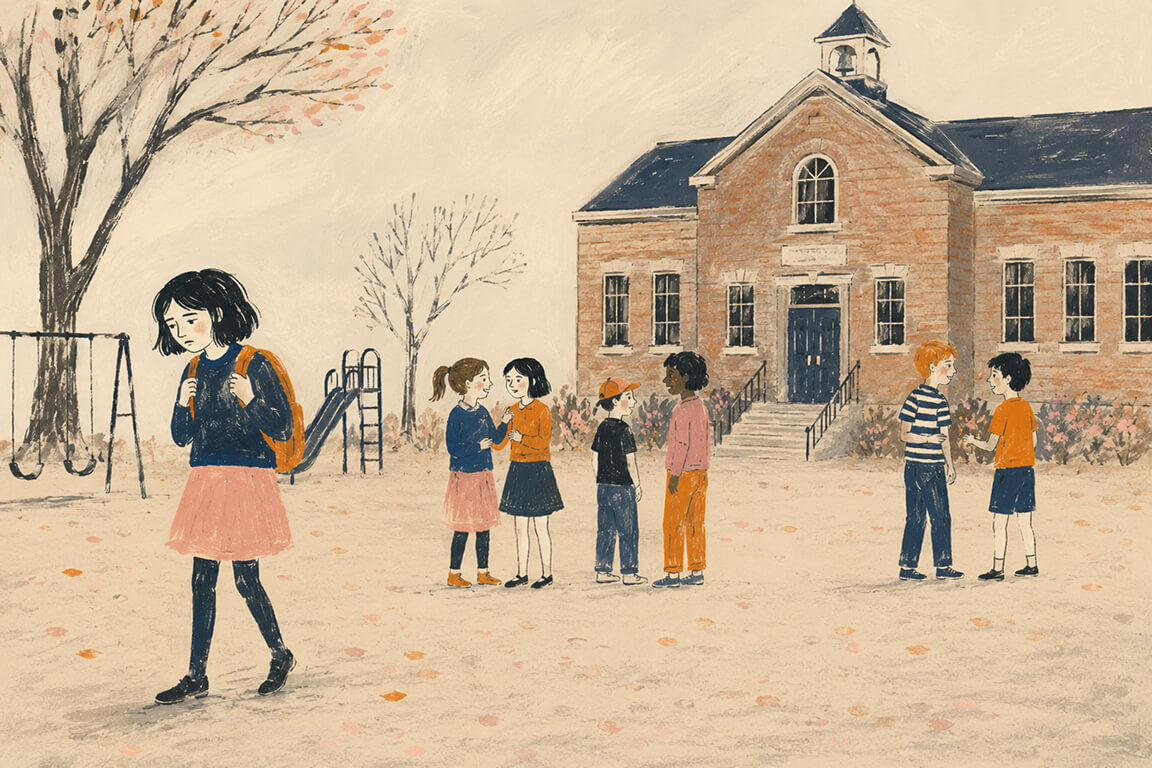
A guide for BC families weighing school safety, criminal conduct, and the risks of police involvement.
Bullying at school is frightening. When it becomes physical, sexual, threatening, or relentless, calling the police can feel like the only door left.
Sometimes it is the right door.
But not every serious harm is best handled by police. Some harms are the school’s responsibility to prevent. Some are human rights issues. Some are failures of supervision, accommodation, or safe-school planning. And police involvement can create new risks, especially for disabled, Black, Indigenous, racialised, queer, trans, and otherwise vulnerable children.
This page is not about whether the harm is serious. It may be very serious. It may be discriminatory, negligent, abusive, or a profound failure of duty.
The narrower question is this:
Is this a police matter, or is the school trying to turn its own failure into someone else’s problem?
This is general information for BC families, not legal advice. For your child’s specific situation, speak with a lawyer.
This guide cannot tell you whether police will investigate, whether charges will be recommended or approved, or whether a particular incident meets the legal threshold for a criminal offence. It is meant to help families sort the question: urgent danger, possible crime, or school safety and accommodation failure. If you are unsure and no one is in immediate danger, you can call the local police non-emergency number and ask how to make a report or whether the situation fits their reporting process.

Start here: a quick triage
Here’s a quick guide for sorting out if police should be called.
Call 911 if there is immediate danger
Call 911 if someone is in danger right now.
That includes situations where:
- a child is being seriously hurt;
- a weapon is present;
- there is a credible threat to life or serious bodily harm;
- your child is at immediate risk of harming themselves;
- your child is missing and there is a real safety concern.
Immediate danger is different from school failure. If someone is unsafe right now, act on safety first.
Consider a police report if there is a specific criminal act
Police can respond to conduct that may be criminal. That may include:
- physical assault;
- sexual assault;
- threats of death or bodily harm;
- criminal harassment;
- extortion;
- theft;
- destruction of property;
- distribution or threatened distribution of sexual images;
- hate-motivated violence or threats.
If the conduct is criminal, document what happened, report it to the school in writing, and consider filing a police report.
If the issue may involve a crime, but no one is in immediate danger, call the local police non-emergency number. Use the police agency for the community where the incident happened. Do not call 911 to ask for the non-emergency number.
For sexual images of a minor, contact police and report to Cybertip.ca.
Use the school and human rights routes if the harm is serious but not criminal
A lot of bullying is devastating without being criminal.
Repeated mockery, exclusion, rumours, sensory targeting, social humiliation, and low-level cruelty can destroy a child’s access to school. That does not mean police can fix it.
When bullying becomes a barrier to your child accessing education, the school has a duty to act. If your child is disabled, neurodivergent, racialised, queer, trans, or otherwise targeted because of a protected characteristic, the issue may also engage the BC Human Rights Code.
Police are for immediate danger and specific criminal acts. Schools are responsible for safety, supervision, accommodation, and access to education.
When those responsibilities are being ignored, the answer is usually documentation, escalation, and external accountability — not necessarily police.
When does bullying become a criminal matter?
Canada does not have one offence called “bullying.” The criminal law looks at the conduct underneath it.
Bullying may become criminal when it involves one or more of the following.
- Assault: Assault includes the intentional use of force without consent. This may include hitting, shoving, choking, kicking, pinning, spitting, or a physical attack that causes injury. A single shove may or may not become a police matter, depending on context and impact. A sustained attack, injury, choking, repeated physical targeting, or any assault the school has failed to stop should be treated more seriously.
- Sexual assault: Any non-consensual sexual touching may be sexual assault. This includes touching through clothing, groping, forced kissing, grabbing, coercion, or sexualised physical contact. If your child has been sexually touched or assaulted at school, do not let the school minimise it as “peer conflict,” “curiosity,” or “inappropriate behaviour.” Report it in writing to the school, preserve evidence, and consider contacting police. If the school knew your child was vulnerable and failed to supervise or protect them, that institutional failure also matters.
- Threats: It may be a criminal offence to knowingly threaten death, bodily harm, damage to property, or harm to an animal. Write down the exact words used. Save screenshots if the threat was online. Note who heard or saw it.
- Criminal harassment: Criminal harassment involves repeated conduct that causes a person to reasonably fear for their safety. This may include following, watching, repeated unwanted contact, threatening messages, or online conduct that spills into real-world fear. The key issue is not whether the other child calls it bullying. The issue is whether your child reasonably fears for their safety because of repeated conduct.
- Sexual images of a minor: If a sexual image of your child, or any minor, has been shared or threatened to be shared, contact police and report to Cybertip.ca. This is one of the clearest situations where police involvement should not wait for the school’s internal process. Before deleting anything, preserve the evidence:
- screenshots;
- usernames;
- phone numbers;
- dates and times;
- URLs;
- messages;
- platform names;
- names of anyone who received or forwarded the image.
Do not forward the image yourself except as directed by police or Cybertip.ca. Preserve evidence carefully.
- Extortion, theft, and property damage: Police may be appropriate where another child is coercing your child for money, food, possessions, passwords, images, or compliance. Police may also be appropriate where property is stolen or deliberately destroyed, particularly if the conduct is repeated, threatening, or targeted.
- Hate-motivated conduct: If violence, threats, or harassment target your child’s race, religion, disability, sexual orientation, gender identity, gender expression, or another protected characteristic, name that clearly in your written report. Hate-motivated conduct may affect how the incident is treated.
What if the bullying is not criminal but is still destroying my child?
This is where many families get stuck. The bullying may not meet the criminal threshold, but your child may still be falling apart. They may be refusing school, self-harming, melting down after pickup, wetting the bed again, dissociating, losing speech, refusing to eat, or saying they want to die. The school may describe the issue as “friendship problems,” “social conflict,” “resilience,” or “student dynamics.”
Do not let soft language erase the harm.
If the school knows your child is being targeted and does not act, that is a school safety problem. If your child is disabled and the bullying interferes with their access to education, that is an accommodation problem. If the school responds by reducing your child’s access to school rather than increasing protection and support, that may become a human rights issue.
Police cannot make a school supervise properly. Police cannot write an IEP. Police cannot force a district to accommodate your child. Police cannot repair a culture where adults minimise harm until the harmed child finally explodes.
For non-criminal bullying, your strongest route is usually to build a written record showing:
- what happened;
- when the school knew;
- what you asked the school to do;
- what the school did or failed to do;
- how the harm affected your child’s access to education;
- how your child’s disability or protected characteristic is connected.
That record is the spine of any school complaint, district appeal, human rights complaint, Ombudsperson complaint, or legal letter.
Where ERASE fits — and where it does not
BC’s ERASE program and Report It tool may be useful for putting a bullying, threat, or safety concern into the district’s safe-school channel. A student can use the tool anonymously or confidentially, and the report goes to the school or district safe-school coordinator.
That can matter. Some children will disclose something through an online form that they cannot say out loud to an adult. A written report may also help show that the school or district knew about the concern.
But families should be clear about what ERASE is and what it is not.
ERASE is not an independent complaint process. It is not a child-protection investigation. It is not a human rights remedy. It does not replace the school’s duty to supervise, accommodate, investigate, and make the environment safe. It does not give families a decision with reasons, a timeline for resolution, disclosure of what was done, or an appeal route if the response is inadequate.
Use ERASE as one record-making route, not as the whole strategy.
If you make an ERASE report, also report the concern directly to the school in writing. Ask what action will be taken, who is responsible, when you will receive an update, and how your child will be kept safe in the meantime.
A reporting tool is only useful if it produces a real response. The existence of ERASE does not prove that the school is safe. The test is what changes after adults are told.
What steps should I try before involving police?
If there is no immediate danger and no specific criminal act, start with the school’s duty to keep your child safe.
1. Report the bullying in writing
Email the classroom teacher or relevant staff member.
Include:
- the date;
- what happened;
- who was involved;
- where it happened;
- who witnessed it;
- how it affected your child;
- what you are asking the school to do.
Avoid framing it as a personality conflict. Use clear language:
My child is being repeatedly targeted at school. This is affecting their safety and access to education. I am asking the school to explain, in writing, what steps will be taken to prevent further harm.
2. Escalate to the principal
If the problem continues, write to the principal.
Ask for:
- a written safety plan;
- increased supervision in specific locations;
- separation from the students causing harm;
- a plan for transitions, recess, lunch, bathrooms, hallways, buses, or online spaces;
- a named adult your child can go to;
- a meeting with written notes;
- a timeline for follow-up.
The question is not “what should my child do differently?”
The question is:
What will the school do to make the environment safe?
3. Name disability and accommodation clearly
If your child is disabled or neurodivergent, say so plainly.
For example:
My child’s disability makes them more vulnerable to this form of targeting and less able to respond or report in the moment. The bullying is now interfering with their access to education. I am asking the school to treat this as both a safety issue and an accommodation issue.
This matters because schools often treat bullying as interpersonal conflict. For disabled children, bullying often becomes an access barrier.
4. Escalate to the district
If the school does not act, contact the district.
Depending on the district, this may include:
- the director of instruction;
- the safe schools lead;
- the inclusive education lead;
- the superintendent;
- the district complaint or appeal process.
You can also use BC’s ERASE Report It tool to put the concern into the safe-schools channel, but do not rely on that alone. ERASE may create a record and trigger follow-up, but it is still routed through the school or district system. It does not replace a written complaint, a safety plan request, a human rights complaint, or legal advice.
Ask what process applies when a parent believes a school has failed to keep a student safe. Ask who is responsible for responding, what will happen next, and when you will receive a written update.
5. Consider external routes
If the internal process fails, possible external routes include:
- BC Human Rights Tribunal;
- BC Ombudsperson;
- Teacher Regulation Branch, if a certificated educator’s conduct is at issue;
- MCFD child protection reporting line, if you believe your child needs protection;
- a lawyer;
- a peace bond, in some situations where there is a reasonable fear of harm.
These routes are not mutually exclusive. A police report does not replace a human rights complaint. A district appeal does not prevent you from seeking legal advice. An internal school investigation does not pause limitation periods.
What should I weigh before calling police?
Police may be necessary. They are also not neutral in their effects.
Before you call police, ask:
- Is there a specific criminal act? Police need something more concrete than “the school is not handling bullying.” They are more likely to act where there is assault, sexual assault, threats, harassment, extortion, weapons, intimate images, or serious property damage.
- Is anyone in immediate danger? If someone is unsafe right now, call 911. If the issue may be criminal but is not urgent, use the local police non-emergency number.
- What outcome am I expecting? A police report may create a record, lead to an investigation, or produce a file number. It will not automatically make the school supervise, accommodate, separate students, or create a safety plan.
- Could police involvement put my child at risk? Police contact can be especially risky for disabled, Black, Indigenous, racialised, queer, trans, and traumatised children. A child who freezes, fawns, masks, or tries to please adults may be misunderstood or pressured into saying things they do not mean.
- Is the school shifting responsibility? If the real issue is that the school failed to supervise, accommodate, investigate, or act on repeated reports, do not let a police report about another child erase the institution’s role.
What if the school wants to call police on my child?
This is a common and serious risk for disabled families.
A child is bullied, provoked, excluded, overloaded, or left unsupported. Eventually they hit, scream, run, throw something, threaten, or melt down. The school responds to the visible reaction while ignoring the conditions that produced it.
The harmed child becomes the “safety concern.”
If the school wants to involve police because of your child’s dysregulation, take it seriously.
Ask what crime they believe occurred
Do not accept vague language like “unsafe behaviour” or “aggression.”
Ask:
What specific conduct are you treating as criminal?
What happened immediately before this incident?
What disability-related supports were in place at the time?
What known triggers, bullying, sensory demands, or unmet needs contributed?
Why is this being treated as a police matter rather than a disability-related support issue?
Ask to be present
If police are going to speak with your child, ask to be present.
Say clearly:
I do not consent to my child being questioned without a parent or lawyer present.
Remember your child has rights
A young person has the right to remain silent and the right to speak with a lawyer. They should not be pressured into explaining themselves to police while dysregulated, frightened, ashamed, or trying to please adults.
Disabled children may be especially vulnerable in police interactions. A child who appears calm may be masking. A child who nods may not understand. A child who gives a long explanation may be trying to escape the situation, not giving a reliable statement.
Put the disability context in writing immediately
After the incident, write to the school and district.
Name:
- your child’s disability;
- the known support needs;
- the history of bullying, exclusion, or provocation;
- what supports were missing;
- what the school knew before the incident;
- why police involvement escalated or mischaracterised the situation.
If your disabled child’s distress is being treated as criminal behaviour, that may itself support a human rights complaint.

Families are often judged in hindsight for decisions they had to make with incomplete information. Calling police too early can create risk; waiting too long can also be criticised later. The goal is not to make a perfect decision. The goal is to act on immediate safety, preserve evidence, create a record, and keep the school’s duty to protect your child clearly in view.
The core test
Before calling police, ask three questions.
Is someone in immediate danger?
If yes, call 911.
Has a specific criminal act occurred?
If yes, consider a police report and preserve evidence.
Is this actually a school safety, supervision, or accommodation failure?
If yes, police may not be the tool that gets your child what they need. Use the school, district, human rights, Ombudsperson, child protection, and legal routes to keep the institution in the frame.
Bullying is not less serious because it falls outside the Criminal Code. A child can be profoundly harmed by conduct police cannot charge.
The school still has a duty to act.
And if the school’s response is to make your child smaller, less present, less believed, or more blamed, document that clearly. The question is not only what other children did to your child.
The question is what the adults knew, what they did, and what they allowed to continue.