
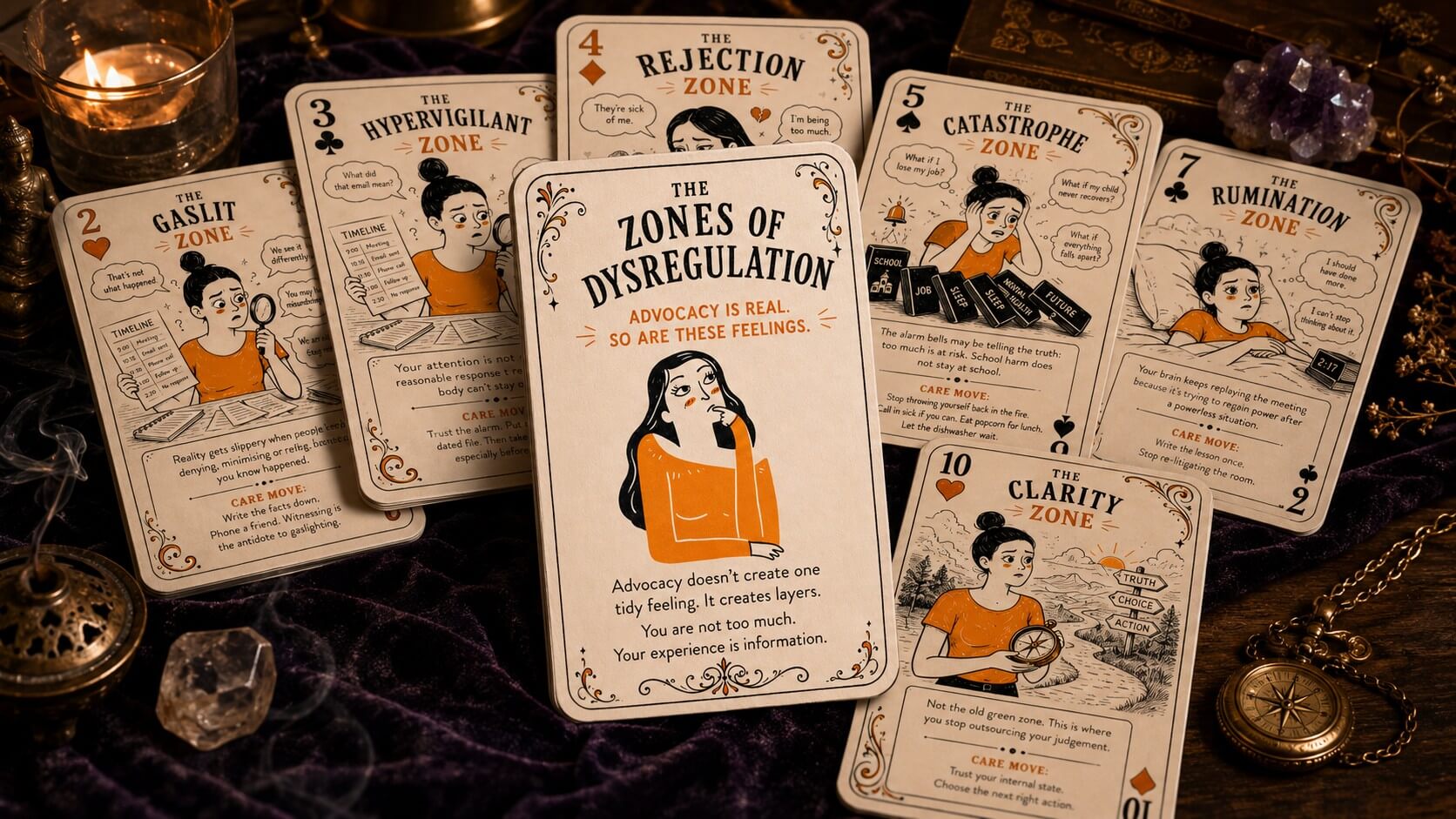
Schools love the Zones of Regulation. Four tidy colours, a laminated chart, a promise that if children can name what they feel and sort it into the correct quadrant, they will learn to manage themselves—quietly, legibly, on schedule. This framework often harms the very children it claims to support: autistic kids, kids with alexithymia, kids whose emotional lives are too plural and too fast and too embodied to be flattened into a traffic light.
The adults who spend years fighting these systems—writing emails at midnight, filing FOIs, sitting through meetings where their child’s suffering is reframed as a behaviour concern—are also living inside a nervous system that is trying to survive. And they deserve a chart too.
So we made one.
The Zones of Dysregulation is a framework for parent advocates. It names ten emotional states that advocacy produces—honest descriptions of what happens to a body that carries too much institutional weight for too long.
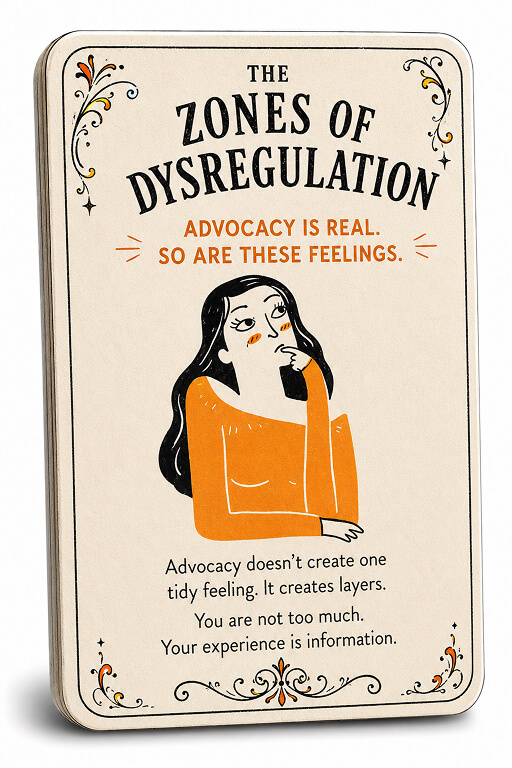
1. The Overwhelmed Zone
Too much. Where do I even start? What if everything falls apart? I can’t keep up.
You are carrying too much, for too long. Your body is in alarm. Your mind is racing. Nothing feels manageable.
The overwhelm is the predictable consequence of being the only person in the room who reads the IEP, tracks the deadlines, documents the pattern, and still has to make dinner and soothe your dysregulated child after school, when they tell you how they really felt about the day. School systems distribute the administrative and emotional burden of accommodation failure almost entirely onto the family—then pathologise the family’s exhaustion as instability.
Care move: Breathe first. Lower the load. Choose one thing to move forward and pat yourself on that back. It more things spring to mind, write them down and then put the list away for today.
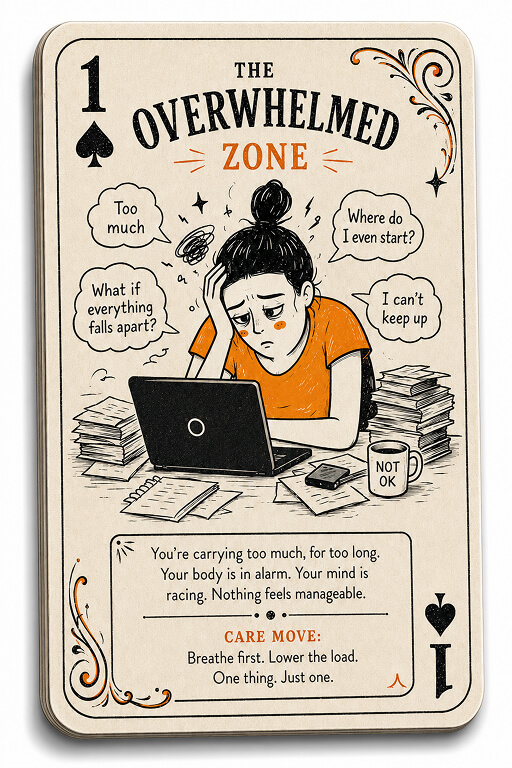
2. The Gaslit Zone
That’s not what happened. We see it differently. You may have misunderstood. We are doing everything we can.
Reality gets slippery when people keep denying, minimising, or reframing what you know happened.
Gaslighting in education advocacy is structural. When a principal says “we see it differently” after your child was excluded from the classroom for the third time this month, or when a district office insists “we are doing everything we can” while your FOI reveals they spent none of their earmarked inclusion funding, the dissonance between your documented experience and the institutional narrative is designed to make you doubt yourself. That disorientation is the point.
Care move: Write the facts down. Phone a friend. Witnessing is the antidote to gaslighting.
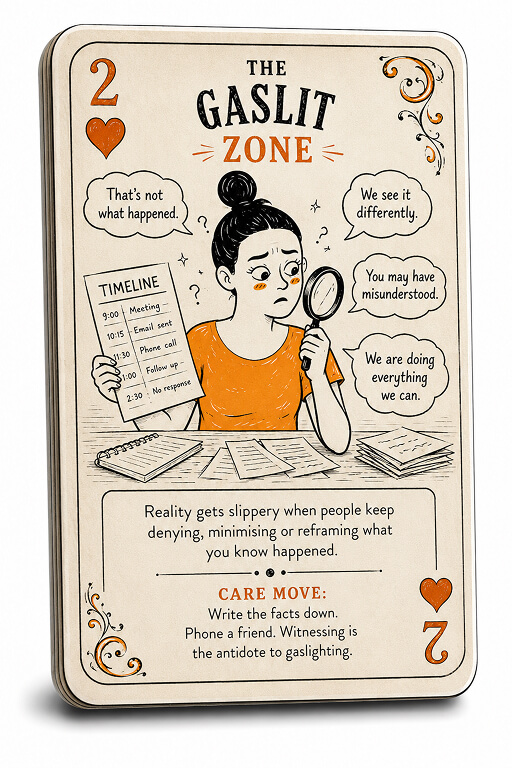
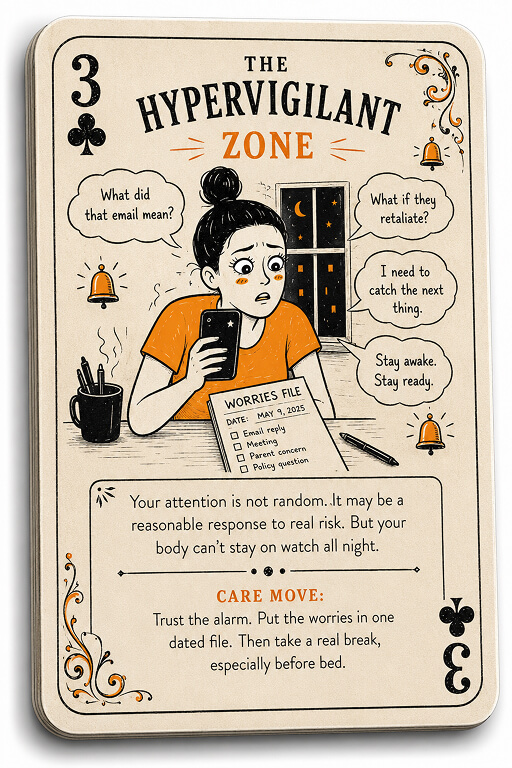
3. The Hypervigilant Zone
What did that email mean? What if they retaliate? What if I’m not doing enough? Stay awake. Stay ready.
Your attention has a reason. It may be a reasonable response to real risk. But your body still deserves rest.
Hypervigilance in advocacy parents develops because the system has, in fact, retaliated—moved a child out of a classroom after a complaint, remembered things differently, gone silent for weeks after a human rights filing. The scanning behaviour is pattern recognition refined by repetition. The difficulty is that your nervous system treats every signal with the same urgency—a genuine threat and a Thursday afternoon email from the school both land as emergency—and so everything becomes dangerous, everything becomes immediate, everything demands action.
Care move: Trust the alarm. Put the worries in one dated file. Then take a real break from worrying after you’ve spent a few minutes taking an action. Worry, especially before bed, doesn’t fix things.
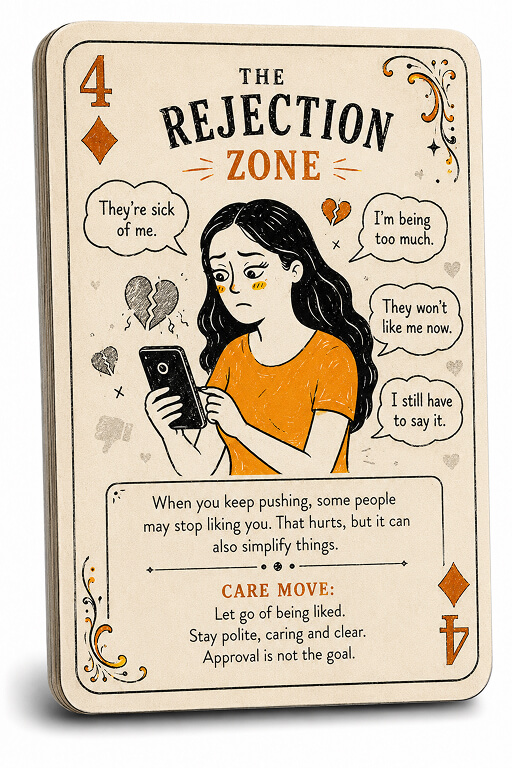
4. The Rejection Zone
They’re sick of me. I’m being too much. They won’t like me now. I don’t want to ever have to talk to them again!
When you keep pushing, some people may pull away. That hurts, but it can also clarify what kind of support you actually have.
Advocacy can make you unpopular. The parent who asks questions at PAC meetings, cc’s the superintendent, or refuses to sign a safety plan that restricts their child’s access to recess may get frozen out, talked about in the parking lot, or quietly dropped from group texts. The rejection is real. It is also information. Some people are comfortable with your distress only when it stays private, polite, and easy to ignore.
Wanting to be liked is human, especially when you are trying to build relationships around your child. But it may help to notice whether you are trying to earn safety through approval. You can be warm, careful, reasonable, and accommodating, and still not get your child what they need. That does not mean you should stop caring about how you treat people. It means your steadiness may need to come from somewhere else: fellow advocates, trusted witnesses, and people who understand why you keep going.
Care move: Let go of being liked. Stay polite, caring, and clear. Approval is not the goal. Find people who understand.
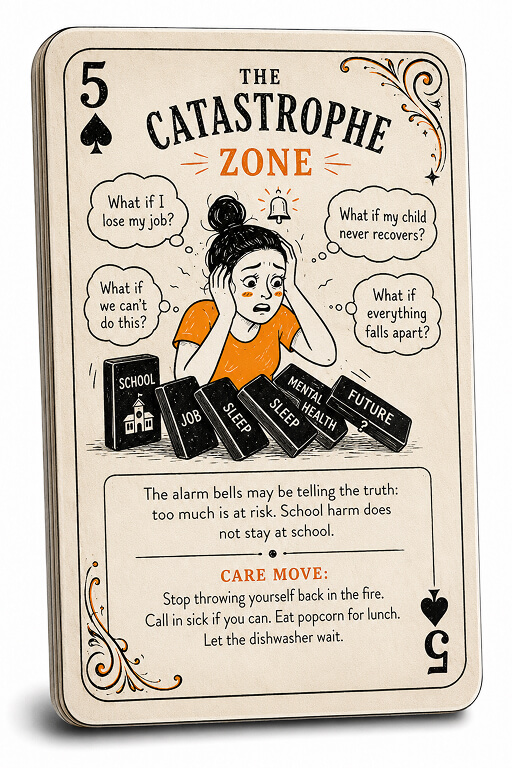
5. The Catastrophe Zone
What if I lose my job? What if my child never recovers? What if we can’t do this? What if everything falls?
Catastrophic thinking in advocacy parents is complicated by the fact that the catastrophes are sometimes real. Children do develop school avoidance that persists for years. Families do lose income when a parent reduces hours to manage crises. Relationships do fracture under the weight of institutional harm that one parent sees clearly and another minimises. These are not imaginary risks.
But the mind often grabs the nearest crisis and treats it as the whole catastrophe. Your child had a meltdown. Another child was hurt. The school says your child cannot come back for a week. That may be serious, painful, and urgent, but the larger catastrophe may be something deeper: the widening gap between your understanding of your child and the way your child is being treated at school. The real question may be whether the current arrangement is becoming unsustainable.
The challenge is to separate the tree from the forest. What is the immediate problem that needs a response today? What is the larger pattern that needs documentation, support, and possibly escalation? Your nervous system may rehearse both at 3 a.m., but they need different kinds of attention.
Care move: Stop throwing yourself back into the fire. Call in sick if you can. Eat popcorn for lunch. Let the dishwasher wait. Then, when your body has had a little evidence of safety, ask: what is the urgent issue, and what is the bigger pattern?
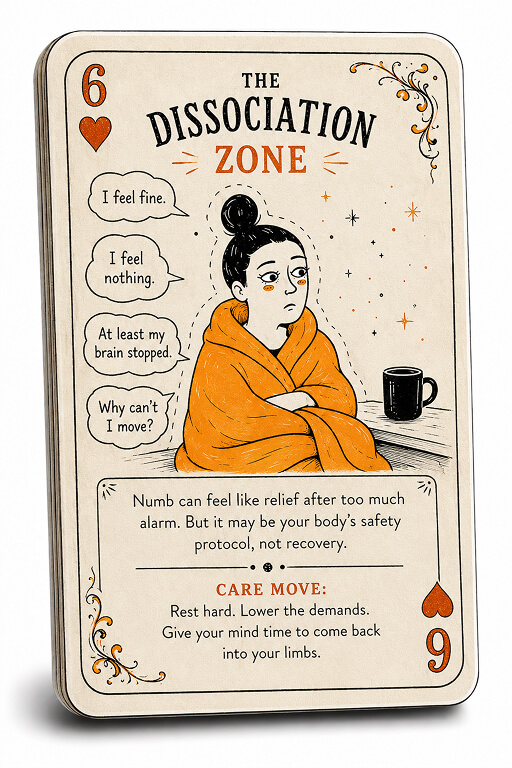
6. The Dissociation Zone
I feel fine. I feel nothing. At least my brain stopped. Why can’t I move?
Numb can feel like relief after too much alarm. But it may be your body’s safety protocol rather than recovery.
Dissociation is the nervous system’s circuit breaker, and for advocacy parents who have spent months or years in sustained fight-or-flight, the sudden absence of feeling can be mistaken for resilience or acceptance. It is the body withdrawing from a situation it has decided is unresolvable, conserving energy by shutting down the very systems—motivation, connection, anger—that kept you going. The stillness can feel like peace, but when you find yourself unable to cry, unable to plan, unable to remember why you started this in the first place, your body is telling you it needs more than rest. It needs permission to stop performing survival.
Care move: Rest hard. Lower the demands. Give your mind time to come back into your limbs.
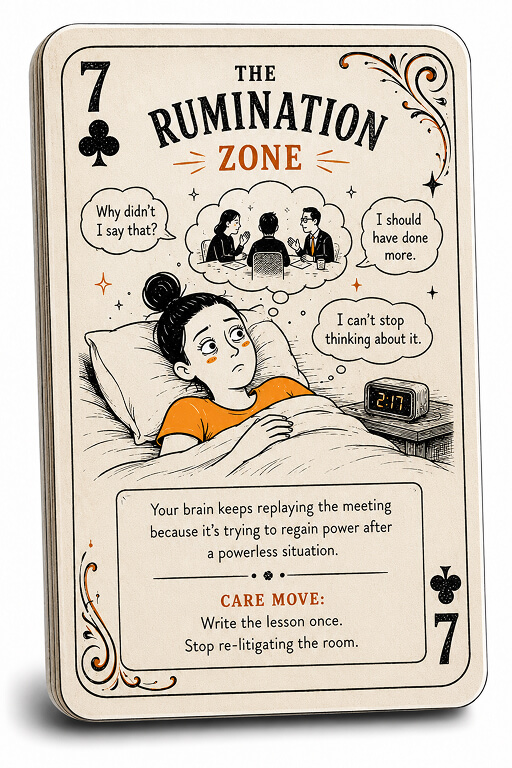
7. The Rumination Zone
Why didn’t I say that? I should have done more. I can’t stop thinking about it.
Your brain keeps replaying the meeting because it is trying to regain power after a powerless situation.
Rumination after an IEP meeting, a complaint response, or a tribunal hearing is your brain’s attempt to rewrite the script—to find the sentence you should have said, the document you should have brought, the moment you should have pushed harder. It is retrospective problem-solving aimed at a situation that has already closed, and it is relentless because the underlying experience—powerlessness in a room full of people who hold authority over your child’s daily life—is so intolerable that your mind would rather loop forever than accept that it happened and move on.
Care move: Write the lesson once. Stop re-litigating the room.
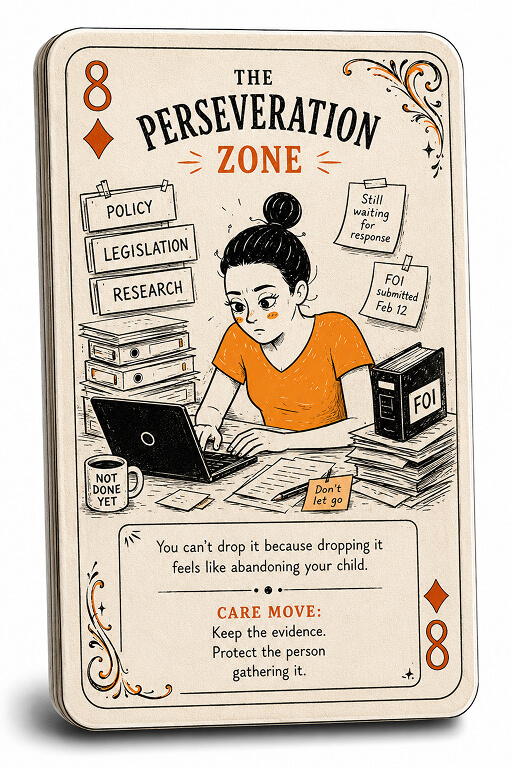
8. The Perseveration Zone
Policy. Legislation. Research. FOI.
You hold on because letting go feels like abandoning your child.
This is the zone where your browser has forty-seven open tabs—Human Rights Code, School Act, FIPPA, district policy manuals, Hansard transcripts, budget documents—and you have spent the last four hours cross-referencing a superintendent’s statement against the ministry’s own data, and your family has been waiting since dinner, and you are telling yourself this is necessary, this is how you protect them, this matters. And it does matter. The research is real, the patterns are real, the evidence you are building may be the only thing standing between your child and further harm. But the person gathering the evidence is also a person, and they are running out of body.
Care move: Keep the evidence. Protect the person gathering it.
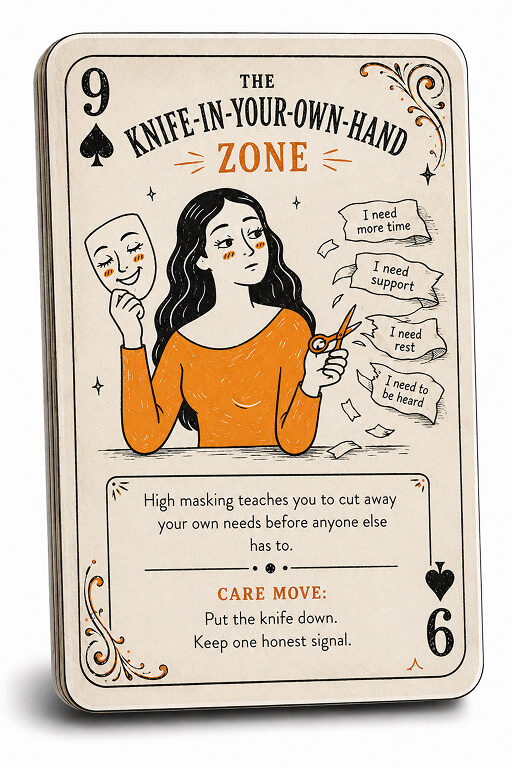
9. The Knife-in-Your-Own-Hand Zone
High masking teaches you to turn the blade inward before anyone else has to.
Years of performing competence, agreeableness, and emotional stability in rooms that are actively harming your child trains you to absorb the cost yourself—to smile through the meeting, to send the polite email, to hold your composure until you are alone and then collapse. The mask becomes a weapon you wield against yourself: every suppressed reaction, every swallowed fury, every “thank you for your time” that tasted like ash carves a little deeper into the person underneath. You are injured by the sustained effort of translating your rage into language institutions will accept.
Care move: Put the knife down.
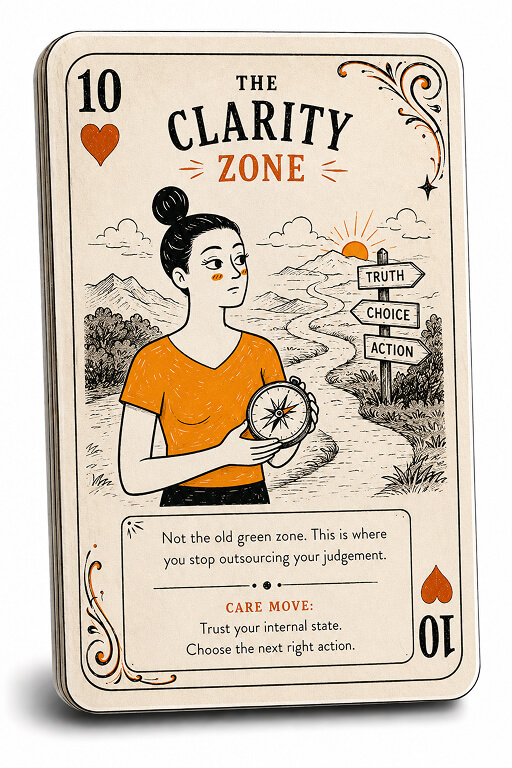
10. The Clarity Zone
Truth. Choice. Action.
This is the zone beyond green. This is where you stop outsourcing your judgement.
Clarity arrives as conviction, as directional force, as the willingness to act on what you already know. It is the moment you stop scanning the institution’s face for permission and start trusting what your body, your evidence, and your child’s experience have been telling you all along. You file the complaint because it is the right thing to do, whether or not it works. You say the hard thing in the meeting because your child deserves someone who says it. You choose the next right action—the honest one, the difficult one, the one that disrupts the comfortable relationship—and you do it with your feet on the ground and your file in your hand.
Care move: Trust your internal state. Choose the next right action.
Why this matters
The Zones of Regulation often asks children to sort complicated inner experiences into a simple colour system, with green held up as the place they are supposed to return to: calm, focused, ready to learn. For many children, especially children with alexithymia, sensory overload, trauma, anxiety, or diffuse emotional awareness, that can turn regulation into performance. The child is not helped to understand the full complexity of what is happening inside them. They are asked to make their distress legible and manageable for the adults around them.
The Zones of Dysregulation refuses that logic.
It starts from a different premise: every state you are in carries information. Your overwhelm is a measure of how much you are carrying. Your hypervigilance is a record of how many times the system proved untrustworthy. Your dissociation is your body’s attempt to survive what your mind has not yet had room to process. Your perseveration is love wearing the only armour it has left.
These zones are fluid, overlapping, and concurrent. You may move between them within a single afternoon, a single meeting, or a single email. You may be furious, numb, grieving, watchful, ashamed, determined, and oddly calm all at once. That does not mean you are failing to regulate. It means advocacy creates layers.
The care moves are not cures. They are interruptions: small acts of mercy directed at the person doing some of the hardest, least recognised, least supported work in the education system. They do not ask you to become smaller, calmer, more palatable, or easier to manage. They ask what your state is trying to tell you, what needs protecting, and what might help you keep going without abandoning yourself.
You are not too much.
Your experience is information.
Your body is not the problem simply because it noticed.