

Many human rights accommodation decisions turn on one word: reasonable. Were the accommodations reasonable? Was the delay reasonable? Given what the school knew at the time about your child’s disability-related needs, was the decision reasonable? It does not have to be the perfect decision — but the school has to be able to justify it. Here is what that means, and how you can use it.
This article summarises and illustrates Kim Block’s What is Reasonable? – Duty to Accommodate.
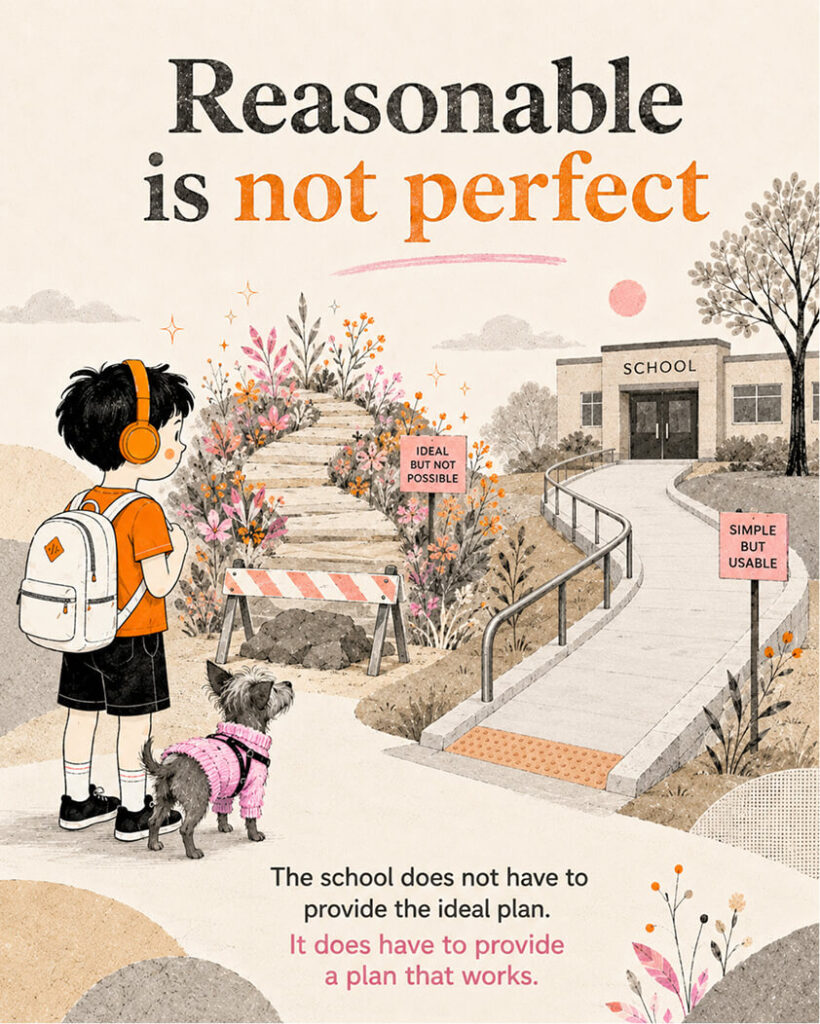
Reasonable is not perfect
The law asks for a reasonable accommodation, not a perfect one. There will often be several routes that could remove the barrier your child faces, and the school does not have to choose the route you would choose — it has to choose one that actually carries your child to equitable access. What counts as reasonable is fact-specific; it turns on your child, their disability-related needs, and the circumstances everyone is looking at in the moment. As the Tribunal put it in X by Y v. Board of Education of School District No. Z (2024 BCHRT 72), drawing on Renaud: accommodation requires a reasonable, not a perfect, solution.
The parent’s role is to communicate the harm, share relevant information, participate in consultation, and keep records. The school’s role is to meaningfully inquire, choose a reasonable accommodation, and explain how that choice addresses the barriers.
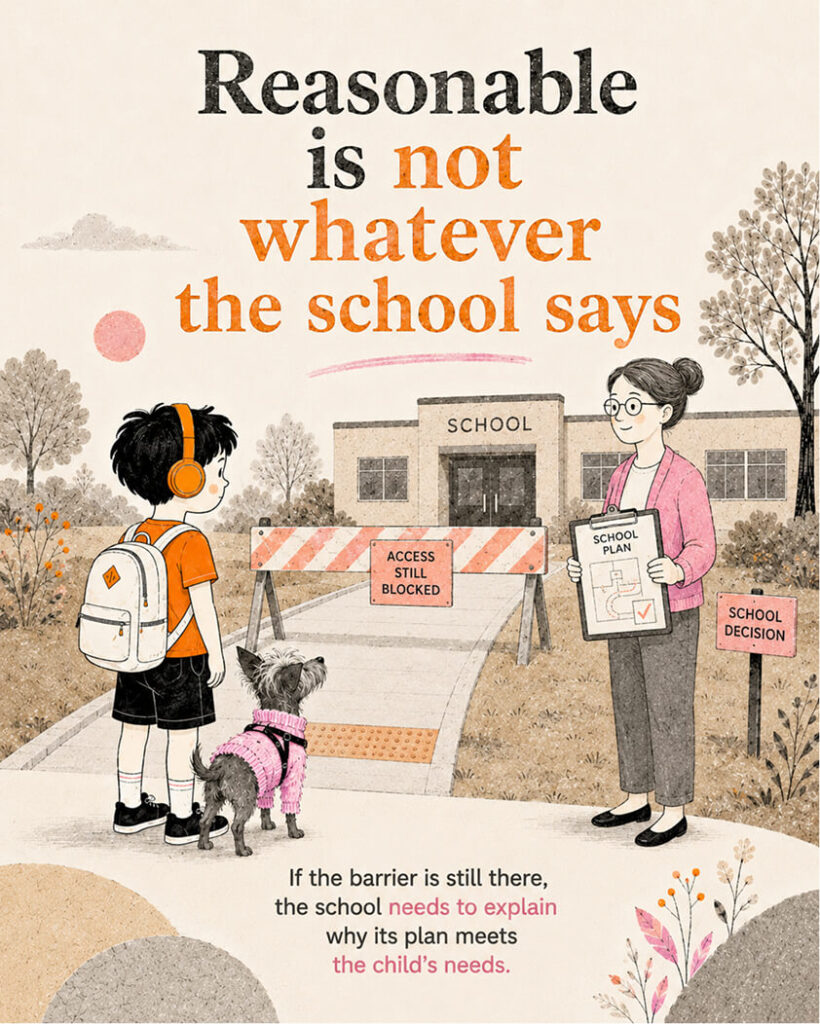
Reasonable is not whatever the school says
A plan on paper is not the same thing as a reasonable accommodation. If the barrier is still standing — if your child is still struggling to reach their education — then calling the plan “reasonable” does not make it so. Reasonableness is a standard, not a label the school gets to stamp on its own work. When a school knows a child is carrying disability-related harm and leaves them in it anyway, that has been found unreasonable; and an unreasonable decision the school cannot justify can amount to discrimination.

Tell them what harm you are seeing
You are the person who knows your child best, and what you witness is evidence. Name the harm plainly — the meltdowns after the bell, the refusal at the door, the lost learning, the toll on body and mind — and link it directly to what is happening at school. This is the move that starts everything: you are handing the school the information it needs to act, and you are making certain so it is much harder for the school to later claim it did not know.

Put the need in writing
Say it, then write it down. An email turns a hallway conversation into a record, and a record is what protects your child months from now. Schools are judged on what they knew at the time, so the moment you see the need, put it in writing — dated, specific, saved. This closes the door on hindsight, the claim that they made a sound decision based on everything they knew, when the thing they knew was sitting unspoken in your worry. Document, document, document.
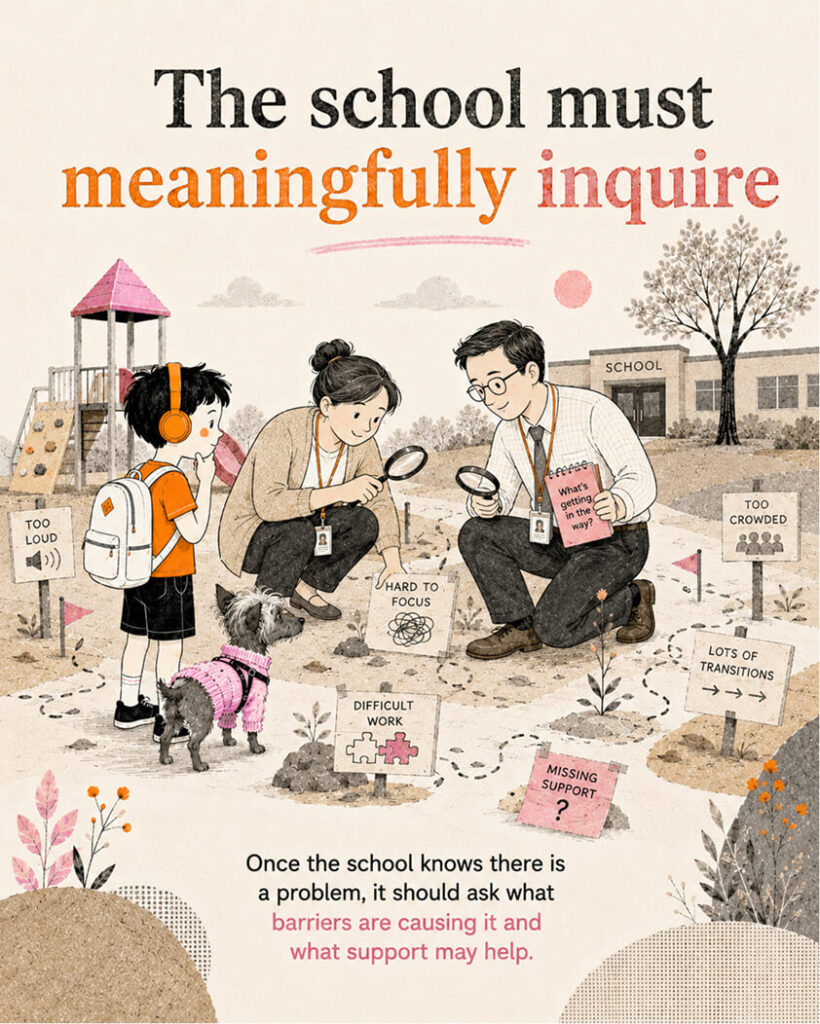
The school must meaningfully inquire
Once the school knows your child is struggling and that the struggle is connected to a disability, it has to look — properly. That means asking what is triggering the difficulty and what supports might lift it, rather than waiting for you to arrive with a finished solution. In Student (by Parent) v. School District (2023 BCHRT 237), a school knew a student lived with anxiety and trichotillomania and that school was taking a serious toll on her — and it did nothing to find out what she needed. The Tribunal found that failure to inquire was unreasonable, the harm was not justified, and it violated the Code.
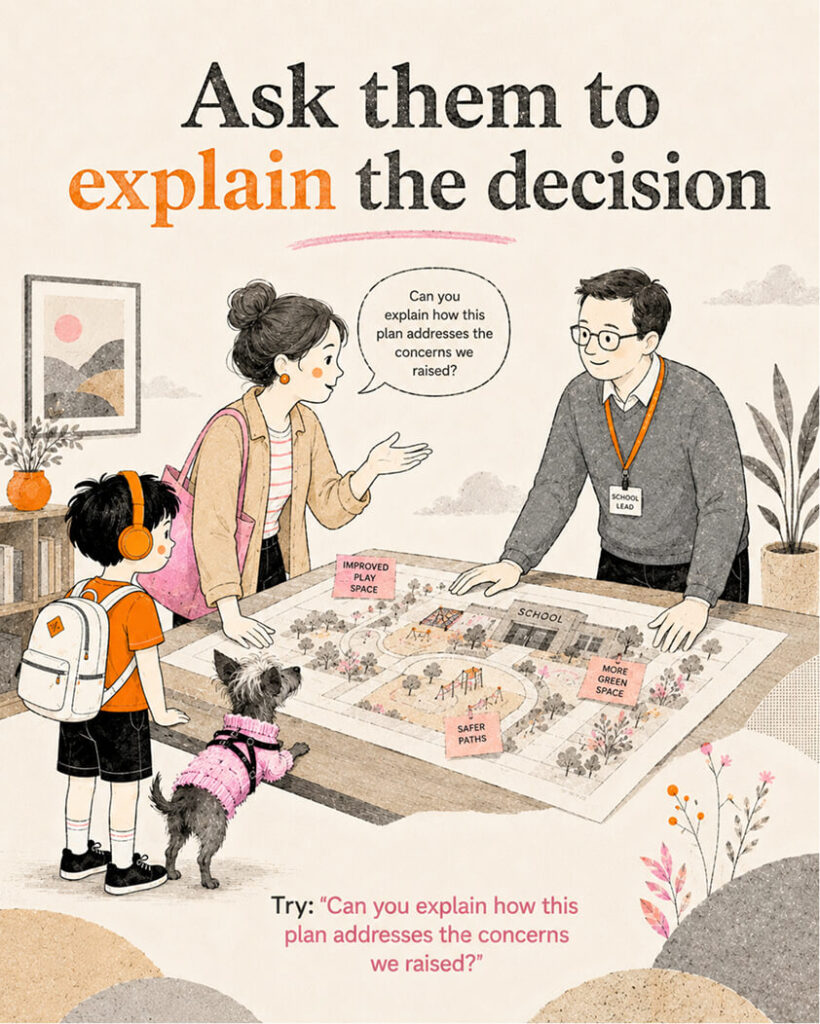
Ask them to explain the decision
Administrative fairness means families should receive clear and meaningful reasons for decisions that affect them. A fair decision can be explained — it is transparent, it is intelligible, it rests on facts and evidence, and it speaks to the concerns you actually raised. Courts applying the Vavilovreasonableness framework look for decisions that are transparent, intelligible, justified, logical, evidence-based, and responsive to central concerns. Kim points to Wells v. Manitoba as an example of that framework being applied in an education-related accommodation dispute. You do not need to use the word “justify.” Ask them to help you understand: can you explain how you arrived at this, so I understand it better? The request is identical; the gentler framing keeps the door open and keeps you in the consultation.
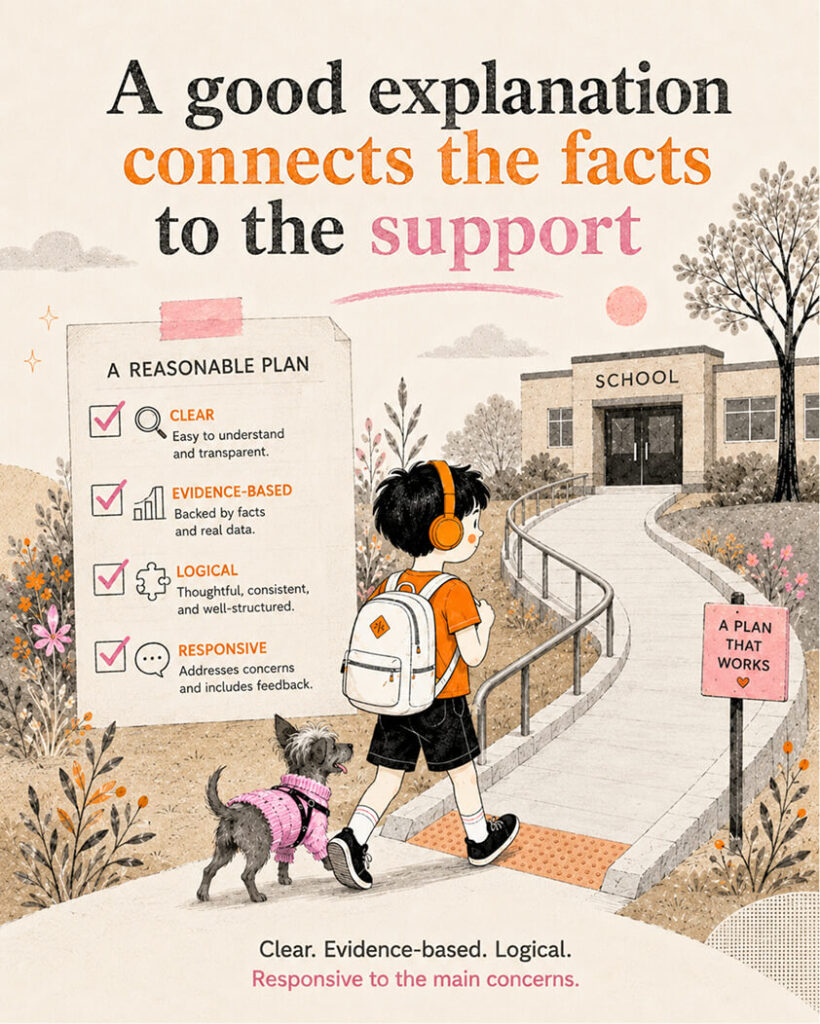
A good explanation connects the facts to the support
When the reasons hold together — when the support plainly answers the need, grounded in what your child genuinely faces — that is a reasonable accommodation, and your child walks a safer, steadier path because of it. When the reasons come apart in your hands, you have found your opening. An explanation that cannot connect the facts to the support is room to push for more. Come back to the test every time: can you show harm? Yes? Then keep going.